
The appearance of the tonsils during a clinical examination guides the practitioner but never solely determines whether the origin is viral or bacterial. Understanding what the terms “white sore throat” and “red sore throat” encompass requires going beyond simple color description to investigate the underlying pathophysiology and the limitations of visual inspection.
Diffuse erythema or purulent deposit: what the oropharyngeal examination really shows
Red sore throat (erythematous) is characterized by uniformly inflamed tonsillar mucosa, with diffuse erythema, edema of the pillars, and bilateral hypertrophy of the tonsils. No exudate is visible on the surface.
Purulent-erythematous sore throat (white) adds to this picture a whitish punctate or plaque-like deposit on the tonsillar crypts. This deposit corresponds to a mixture of fibrin, necrotic cells, and polymorphonuclear leukocytes, not “pus” in the surgical sense of the term.
We regularly observe that the description reported by the patient (“I have white spots in my throat”) does not always correlate with what the examination finds. A simple thick salivary coating, chronic tonsillar caseum, or oropharyngeal candidiasis can mimic a purulent appearance. The distinction requires proper lighting and often a tongue depressor to visualize the lower pole of the tonsils.
To better visualize what a white or red sore throat looks like, a comparative photographic support remains more reliable than any textual description.
Viral or bacterial sore throat: why color does not guide the diagnosis
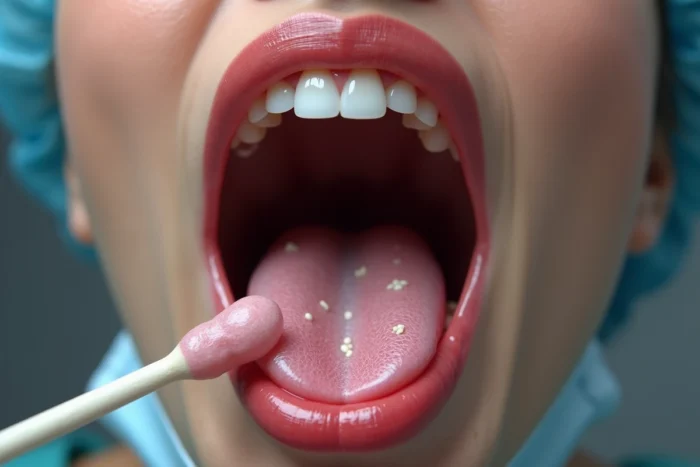
The red or white appearance of the throat does not allow for distinguishing a viral sore throat from a bacterial sore throat. Current recommendations from the HAS are categorical on this point, and we emphasize this data because it remains poorly integrated into everyday practice and in most public content.
A beta-hemolytic group A streptococcus (GAS) can cause a strictly erythematous sore throat, without any white deposit. Conversely, infectious mononucleosis (Epstein-Barr virus) frequently produces an impressive purulent exudate, sometimes confused with streptococcal sore throat.
Other possible etiologies for a “white” appearance of the tonsils include:
- Oropharyngeal candidiasis, particularly in immunocompromised patients or those on inhaled corticosteroids, generates a diffuse whitish coating that often extends beyond the tonsils to the palate and tongue.
- Vincent’s angina (fusospirochetal) causes unilateral ulceration covered with a grayish coating, with foul breath and preserved general condition.
- Chronic tonsillar caseum, benign, presents as whitish-yellow concretions in the crypts, without fever or peripheral inflammation.
The direct clinical consequence: the prescription of antibiotics should never rely solely on visual inspection. The rapid streptococcal diagnostic test (TROD) remains the key to the decision tree.
Common symptoms and distinguishing signs between red and white sore throat
The basic clinical picture is shared. Rapid onset sore throat, dysphagia (pain on swallowing), variable fever, sensitive cervical lymphadenopathy. These signs do not allow for distinguishing the two forms.
Some nuances deserve attention:
- Viral erythematous sore throat is more often accompanied by associated rhinopharyngeal signs (rhinorrhea, cough, hoarseness), indicating diffuse involvement of the upper airways.
- Streptococcal purulent sore throat frequently begins abruptly, with a high fever without signs of rhinitis, abdominal pain in children, and sometimes a scarlet fever-like rash.
- Infectious mononucleosis with white sore throat is accompanied by marked asthenia, splenomegaly, and diffuse lymphadenopathy, not just cervical.
In children under three years old, GAS sore throat is rare. The majority of sore throats in this age group are viral, regardless of their appearance. The TROD is not recommended before three years of age.

Streptococcal TROD and McIsaac score: differential diagnostic tools
The McIsaac clinical score combines five criteria (fever above 38 °C, absence of cough, anterior cervical lymphadenopathy, tonsillar exudate, age) to estimate the probability of a GAS infection. A low score makes streptococcal etiology unlikely and dispenses with the TROD.
The TROD detects GAS antigens in a few minutes from an oropharyngeal sample. Its specificity is high: a positive test justifies antibiotic therapy. A negative test, in the absence of particular context, allows for reassurance and the prescription of only symptomatic treatment.
We recommend not prescribing antibiotics “as a precaution” for a white sore throat without microbiological confirmation. The overprescription of amoxicillin based solely on the purulent appearance remains a public health issue, directly contributing to antibiotic resistance.
Complications of untreated bacterial sore throat
Untreated GAS sore throat exposes patients to locoregional and systemic complications. Peritonsillar phlegmon presents with trismus, deviation of the uvula, and a “hot potato” voice. It requires urgent drainage.
Post-streptococcal complications (acute rheumatic fever, glomerulonephritis) have become rare in high-income countries, but they alone justify the rigorous diagnostic strategy surrounding the TROD. The therapeutic window to prevent ARF remains open for up to nine days after the onset of symptoms, allowing time to confirm the diagnosis before treatment.
Viral sore throat, regardless of its presentation, heals spontaneously within a few days. Treatment relies on analgesics and antipyretics. Non-steroidal anti-inflammatory drugs at anti-inflammatory doses should be avoided, as they increase the risk of suppurative complications.
Differentiating a white sore throat from a red sore throat remains a useful semiological exercise, but the clinically relevant question is not “what color?” but “what germ?”. Only the TROD, coupled with clinical evaluation, allows for the rigor that the situation demands.