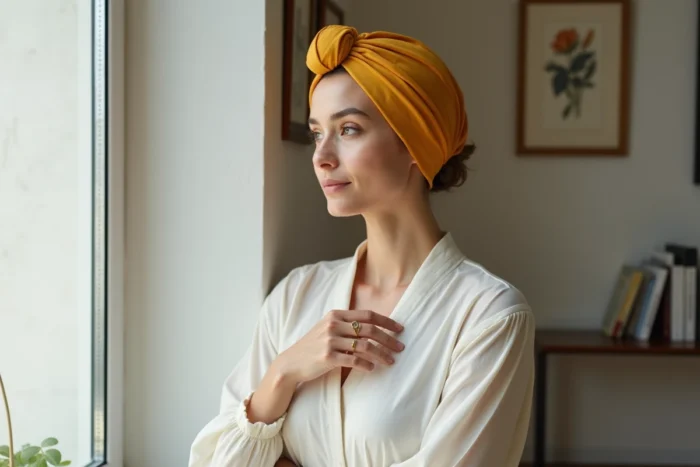
The turban is no longer just a simple hair accessory: it is a fully-fledged technical tool, capable of protecting hair fibers as well as structuring a look. We have observed a rise in the quality of materials and cuts over several seasons, repositioning the turban far from the basic twisted cotton. Understanding textile properties and tying methods allows you to make the most of this piece, regardless of hair texture.
Technical materials for turbans: satin, silk, and microfiber versus cotton
The choice of fabric determines both the aesthetic result and the impact on hair health. Cotton, long considered standard, absorbs moisture from the fiber and generates friction responsible for breakage on textured hair.
Satin and silk reduce friction and maintain the hydration of the hair shaft. This is why these materials now dominate high-end ranges, suitable for both daytime and nighttime use. Satin turbans serve as protection during sleep to preserve curl definition, limit frizz, and prevent breakage, a common practice in natural hair care routines for afro, curly, or locked hair.
Microfiber, more recent in this segment, offers an interesting compromise: lightweight, quick-drying, and surface softness comparable to satin. We recommend checking the fabric’s weight before purchase, as overly thin satin slips and doesn’t stay in place, while overly thick microfiber can make the scalp sweat. The catalog available at madame-turban.fr illustrates this diversity of materials suited to different hair needs.
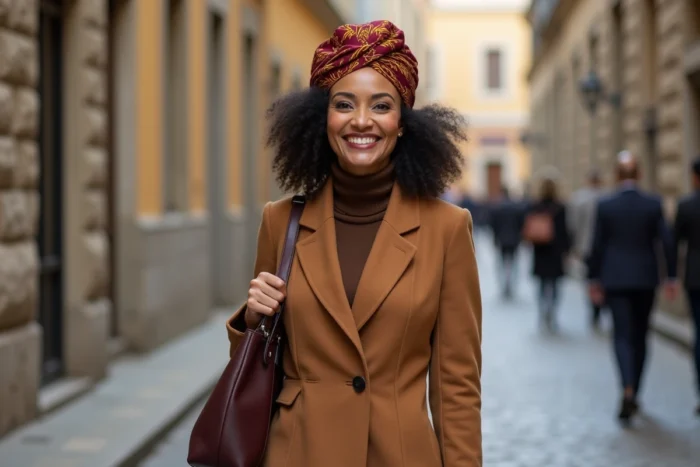
Turban and face morphology: adapting volume and tying
An improperly proportioned turban squashes a round face or excessively elongates an oval face. The tying technique is as important as the fabric.
Formats and proportions to know
- The mini format, which partially covers the head, is suitable for slender faces, short hair, and children. It adds structure without overwhelming.
- The classic format, more covering, works on most morphologies as long as the height of the front knot is adjusted. A high knot elongates, while a low knot widens.
- The maxi or full wrap format envelops the entire hairstyle. It is the most protective but requires a fabric long enough (at least one meter fifty of panel) and a precise folding technique to avoid the “mushroom” effect.
The height of the front knot alters the perception of the face shape. For a square face, slightly offsetting the knot to the side breaks the symmetry and softens the angles. For an elongated face, a turban worn low on the forehead, like a wide headband, rebalances the proportions.
Crossover or twisted tying: two schools
The crossover tying (the two ends overlap on the forehead and then fold back) creates a structured look, suitable for a sophisticated or professional style. The twisted tying (each end is twisted before being brought back) creates volume and movement, more consistent with a bohemian or casual style.
We observe that tying tutorials are multiplying, but few mention a crucial technical point: the initial tension of the fabric on the nape. If the turban is not sufficiently adjusted at the base of the skull, it slips within the hour. A tip is to secure a thin headband underneath to serve as an anchor, especially on straight hair.
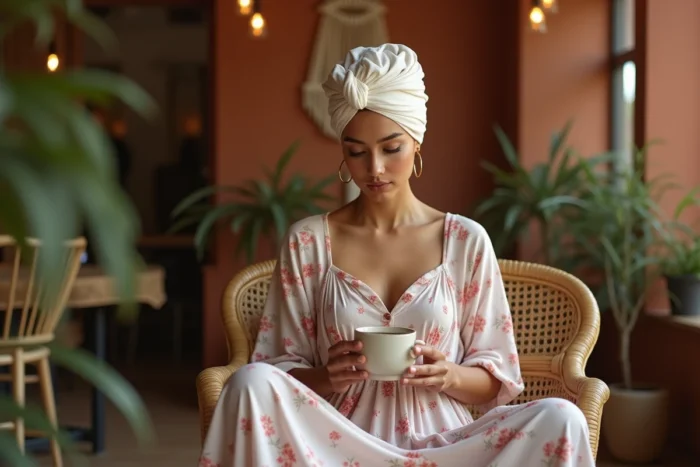
Turban colors in 2026: palettes that really work
The hair accessory trends for 2026 confirm two clear chromatic directions. On one side, neutrals (black, beige, gray) remain the most versatile for everyday use. They integrate effortlessly into a wardrobe and suit all skin tones.
On the other side, pastels (powder pink, lavender) are prominent in the spring-summer seasons. These shades work particularly well on satin turbans, whose surface reflects light and amplifies the softness of the color.
For those looking to step outside these two ranges, deep colors like olive, rust, mustard, bordeaux, and peacock blue are regularly highlighted in turban-outfit coordination guides. The rule we apply: the turban takes a secondary color from the outfit, never the dominant color, to avoid a flat monochrome effect.
Night turban and hair care routine: an underestimated use
The night turban made of silk or satin is not a gimmick. For textured hair (tight curls, afro, locks), sleeping without textile protection causes friction against the pillow that destroys curl definition and promotes breakage.
A satin night turban keeps curl definition until the next day. The principle is simple: the smooth surface prevents the hair from snagging on the fibers of the fabric. On straight or wavy hair, the benefit is less pronounced but real, especially for maintaining a blowout or straightening.
- Prefer a model with an adjustable elastic rather than a simple square of tied fabric, which comes undone during the night.
- Choose a double-layered satin (two layers) for thick hair: the slight rigidity of the lining better maintains the enclosed volume.
- Wash the night turban every two weeks to avoid the accumulation of sebum, which eventually saturates the fabric and negates its sliding properties.
The night turban differs from the satin bonnet by its cut: it leaves the nape free, which reduces the feeling of heat. For those sensitive to nighttime sweating at the scalp level, this is a determining choice criterion.
The turban is a full-fledged hair and care accessory, not just an ornament. Material, format, tying, color: each parameter influences the final result on the hair and on style. Approaching this accessory with the same rigor as a hair product allows you to exploit its full potential, day and night.