
An elderly person, sometimes in their nineties, who whispers “mom” in a nursing home corridor or in the middle of the night is not expressing a whim. This behavior, observed in both individuals with Alzheimer’s disease and seniors without a dementia diagnosis, stems from a specific psychological mechanism: the return to the primary attachment figure when the brain loses its temporal and relational bearings.
Understanding why elderly individuals call for their mother with emotion requires distinguishing between what relates to neurology, affective memory, and daily life context.
Primary attachment and emotional memory in the elderly
The attachment theory, formulated by psychiatrist John Bowlby, describes a biological bond between the child and their security figure (most often the mother). This bond does not disappear with age. It goes dormant, masked by cognitive abilities that allow the adult to manage their anxiety independently.
When these abilities decline, due to brain aging or a neurodegenerative disease, the attachment system reactivates. The person instinctively seeks the presence that, in their early years, represented absolute security. The word “mom” is not a call directed at a living or deceased person: it is a request for comfort encoded in emotional memory.
Several factors explain why the reasons why an elderly person calls their mother go beyond mere nostalgic memory. Procedural and affective memory (the memory of sensations, emotions, and learned gestures from an early age) lasts much longer than episodic memory, which pertains to recent events. An Alzheimer’s patient who no longer recognizes their adult children may still feel the emotional imprint of the maternal bond.
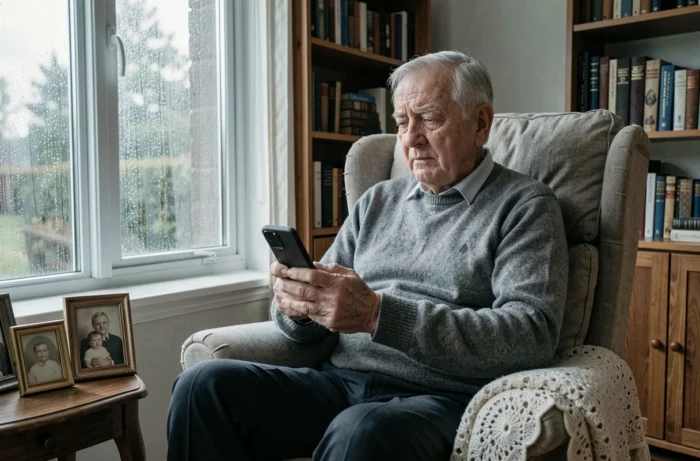
Alzheimer’s disease and cognitive disorders: when language reduces to calling
In individuals with dementia, language disorders progress in stages. Vocabulary diminishes, syntax simplifies, and the words that remain are those carrying the strongest emotional weight. “Mom” is among the very last words to disappear from the verbal repertoire.
The brain thus retains the emotional trace of the maternal bond long after losing memory of events. Emotional memories, anchored in brain structures distinct from those managing factual memory, persist while the recall of recent facts gradually fades.
What the call expresses beyond the word
Reducing these calls to a “symptom of dementia” would be a mistake. The category of “disruptive behavior disorders” describes the effect on those around, not the function of the behavior for the person themselves. Behind the word “mom,” several states coexist:
- A temporal disorientation: the person no longer knows how old they are and perceives themselves as a child in need of protection.
- An anxiety related to the environment: noise, darkness, a change of room, or the absence of a familiar face trigger a feeling of insecurity that only the reflex to call can express.
- An unidentified physical pain: when language can no longer describe pain, the body reverts to the most archaic signal, the call to the mother.
- A feeling of helplessness in the face of loss of autonomy, amplified by social isolation or loneliness in an institution.
In end-of-life care, testimonies collected in hospital and hospice settings confirm that the name “mom” emerges as a recurring motif of emotional recall, even among very elderly patients. This observation shifts the explanation from solely the realm of dementia to that of returning to the primary security figure, a mechanism shared by individuals without a specific cognitive diagnosis.
Isolation and loneliness: an underestimated amplifier
Recent research on loneliness among older adults offers a broader explanatory framework than mere maternal nostalgia. Chronic social isolation exacerbates calling behaviors, whether through repeated phone calls to children or cries directed at caregivers.
In institutions, incessant calls are not just an individual issue. Professional literature emphasizes that they also exhaust staff and other residents, creating a vicious cycle: the person calling receives increasingly brief or exasperated responses, which reinforces their anxiety and the frequency of their calls.
The role of rhythm in communication
Structured conversation programs for individuals with dementia now emphasize the right rhythm of communication, not just its frequency. Regularity reconstructs a minimal temporal framework for a person who has lost their bearings. A predictable exchange, at a stable time, provides an anchoring that spaced and random contacts cannot offer.
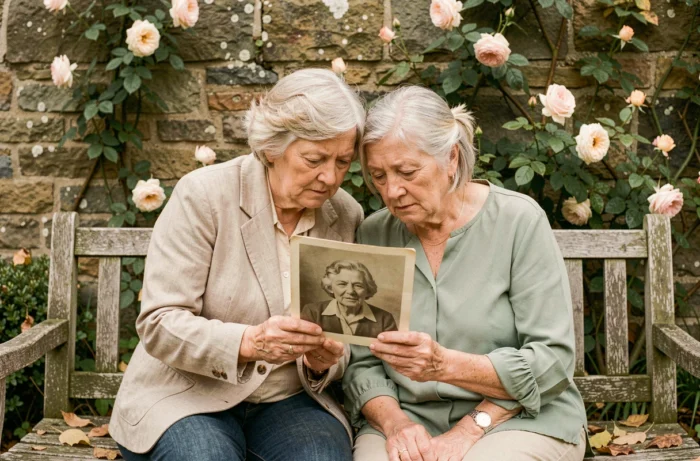
Responding to emotion rather than correcting speech
To say “Mom has been dead for a long time” to someone calling for their mother evokes a fresh grief with each repetition. The brain affected by dementia does not retain factual information but perfectly records the emotional distress caused by the announcement. The person will forget the phrase, but not the pain they felt.
Emotional validation consists of welcoming the expressed feeling without contradicting it. In response to a parent calling for their mother, an appropriate response acknowledges the underlying need: “You are thinking of your mom; she meant a lot to you.” This formulation does not assert that the mother is alive, but it also does not force a reality check that the person cannot integrate.
Several principles guide this approach:
- Validate the emotion before any attempt to distract or redirect to the present.
- Use a calm tone of voice and gentle physical contact (hand on the shoulder) to reproduce the sense of security sought.
- Observe what precedes the call (change of environment, pain, time of day) to identify the real trigger and respond concretely.
The call to the mother in an elderly person is neither a literal return to childhood nor a sign that the relationship with current loved ones has failed. It is the last available language to express a need for security when all other codes have been erased by illness or age. Welcoming this word as a signal rather than a problem to be solved changes the quality of support, for both the person and their surroundings.