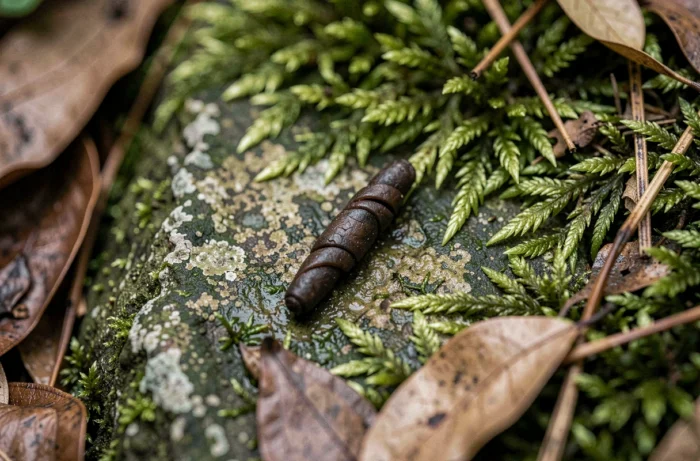
On a a damp forest trail, a small dark mass resting on a stone or a dead leaf catches the eye. This discreet deposit, often overlooked, may indicate the presence of a spotted salamander in the area. Correctly identifying this droppings confirms that an amphibian sensitive to pollution frequents the environment, without needing to encounter the animal itself, which is often nocturnal and elusive.
Appearance and texture of spotted salamander droppings
In the field, one rarely stumbles upon salamander droppings by chance. You need to know what to look for. The droppings are small, elongated or slightly irregular in shape, with a color ranging from dark brown to black. Their size remains modest, proportionate to an animal that rarely exceeds twenty centimeters.
The most reliable criterion to avoid confusing them with rodent or insect droppings is the visible composition. Upon closer inspection, one often distinguishes fragments of insect shells, larvae, or slugs. These chitinous remains give the droppings a granular appearance, sometimes slightly shiny, very different from the smooth droppings of a mouse or a vole.
Another point to check: the possible presence of a whitish urate deposit at one end. Like reptiles and birds, amphibians sometimes excrete part of their nitrogenous waste in the form of uric acid, which produces this chalky mark. Mammals do not have this characteristic. If one observes a small dark droppings with a white tip, one can immediately rule out rodents and direct the search towards an amphibian or a reptile.
When trying to recognize salamander droppings, it is also important to consider the location of the discovery. An isolated droppings on a dry slab in full sun is unlikely to belong to a salamander. In contrast, if found under a stump, near a wall of damp stones, or at the edge of a spring, the hypothesis becomes coherent.
Confusion with mouse, toad, and other species droppings
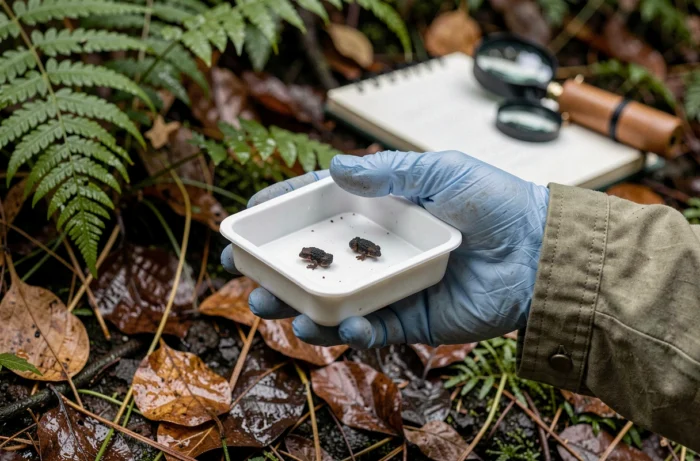
The most common confusion involves mouse or vole droppings. These rodents leave cylindrical, smooth, uniformly dark droppings, without visible insect residues. They are also more regular in shape, often deposited in clusters along a path.
With the common toad, the distinction is more subtle. The toad is also an insectivorous amphibian, and its droppings also contain shell remains. The difference lies in size: an adult toad produces droppings that are significantly larger than those of a salamander. The context also helps, as the toad frequents more open areas (gardens, lawns) while the salamander prefers damp undergrowth and the edges of waterways.
To avoid misidentification, here are the criteria to systematically cross-reference:
- The presence of insect or slug fragments in the droppings, a sign of an insectivorous diet typical of amphibians
- The location in a damp, shaded area, with forest or rocky soil, far from dry and open spaces
- The small size of the droppings, consistent with a small-bodied animal, which rules out larger species like hedgehogs
- The possible white urate deposit, which rules out mammals
None of these criteria alone is sufficient. It is their combination that makes identification reliable.
Salamander and biodiversity: why this droppings is an indicator of a healthy environment
The spotted salamander is poorly tolerant of pesticides, synthetic fertilizers, and soil degradation. Its permeable skin directly absorbs pollutants present in water and substrate. Finding its droppings indicates a little contaminated environment, with moist soils and active microfauna (worms, slugs, soil insects).
In a garden, spotting a salamander droppings is more significant than seeing a blackbird or a lizard. The latter adapt to degraded environments. The salamander does not. Its presence reflects a superior ecological quality of the soil and water nearby.
For amateur naturalists participating in citizen inventories or distribution atlases, the droppings constitute an acceptable presence indicator. One does not always encounter the animal, which is mainly active at night and in rainy weather. But its droppings, deposited near its daytime shelters (flat stones, stumps, cavities), confirm that a population frequents the area.
Where and when to look for salamander droppings in the forest
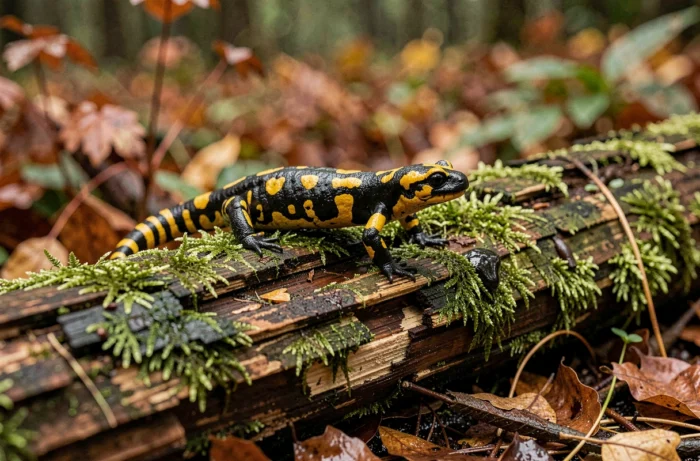
There are better chances of finding salamander droppings in specific areas. The undergrowth of deciduous trees with rich litter soil is the preferred terrain. The edges of forest streams, dry stone walls, and entrances to caves or natural galleries also concentrate observations.
The season matters. Salamanders are mainly active in spring and autumn when humidity and mild temperatures coincide. In dry summer or harsh winter, they retreat to underground shelters and leave far fewer traces on the surface.
In the field, it is recommended to search:
- Under flat stones or logs that have been on the ground for a long time, gently turning them over and replacing the shelter afterwards
- Along the banks of small shaded streams, especially upstream of urban areas
- In old walls or piles of stones, where cavities offer permanent refuges
Searching after a night of autumn rain multiplies the chances of finding fresh droppings, as salamanders come out en masse to hunt under these conditions.
Spotting a salamander droppings on a forest trail provides concrete information about the state of the environment. No need for expensive equipment or nighttime outings: a keen eye in the right places and at the right seasons is enough to turn a simple droppings into a useful naturalist data.