The awakening and well-being of children are subject to rapid regulatory changes in France. The framework surrounding early childhood has tightened regarding screens, while new public guides aim to provide parents with reliable benchmarks from birth. These changes also affect the daily lives of professionals in nurseries and childminders.
Screens and Young Children: What Changes with the Order of June 27, 2025
Since an order published in the Official Journal on July 2, 2025, the national charter for the reception of young children formally prohibits any exposure to screens for children under 3 years old in both collective and individual care settings. Nurseries, micro-nurseries, and childminders: television as background noise is now banned, even when turned on without educational intent.
This prohibition is not merely a reminder of good practices. It is part of a regulatory text that is enforceable against care establishments, meaning that inspections by the PMI (Maternal and Child Protection) can rely on this framework to assess a structure’s compliance.
In parallel, since January 2025, the recommendation “no screens before 3 years, even as background noise” is included in the health booklet given at every birth in France. Among the recent articles from Douceur Enfance, several insights discuss how these new rules translate into daily life for families.
Field feedback varies on this point: some early childhood professionals believe that the prohibition lacks clarity regarding digital tools used for educational purposes (occasional image projection, musical support), while others see it as a long-awaited clarification.

Guide “The Keys to Childhood 0-3 Years”: A Public Reference for Parents
The guide “The Keys to Childhood 0-3 Years,” published in October 2025 by the ministry responsible for early childhood, is aimed directly at parents. It gathers benchmarks on baby development, available childcare options, and administrative procedures related to birth.
This document is part of the dynamic of “the first 1,000 days”, a program targeting the period from conception to the child’s third year. The guide does not replace medical follow-up but centralizes information that was previously scattered across various institutional sites.
One point deserves attention: the guide emphasizes the importance of a protective environment and attentive listening, without proposing a self-assessment grid for parents. The available data do not allow for measuring the concrete impact of this type of document on family practices, but its systematic distribution through maternity wards ensures broad coverage.
Psychomotor Development in Nurseries: Between Professional Training and Staffing Reality
The support for the psychomotor development of young children largely relies on the training of early childhood professionals. Care establishments are required to offer activities suited to each age group, but the quality of this support depends on several concrete factors:
- The actual staff-to-child ratio in the structure, which conditions the time available for individual observation of each child
- The ongoing training of childcare assistants and early childhood educators, particularly on sensory and motor approaches
- The arrangement of the space: floors suitable for free movement, child-height furniture, quiet areas distinct from active play spaces
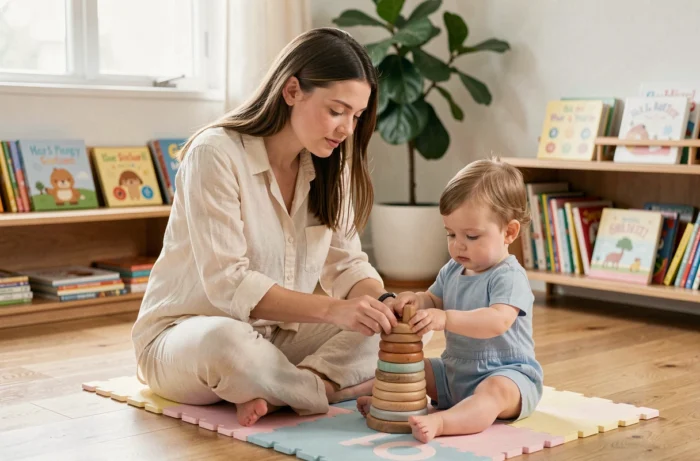
Free movement, inspired by the work of Emmi Pikler, remains a pillar of awakening in nurseries. The principle is simple: allow the child to explore their motor abilities at their own pace, without placing them in a position they do not yet master (propped sitting, standing held by the arms).
However, the implementation varies by structure. Micro-nurseries, with smaller groups, often provide a more conducive environment for careful observation. Large collective nurseries must deal with larger numbers, making individual follow-up more complex.
Child Well-Being at Home: What the Regulations Do Not Cover
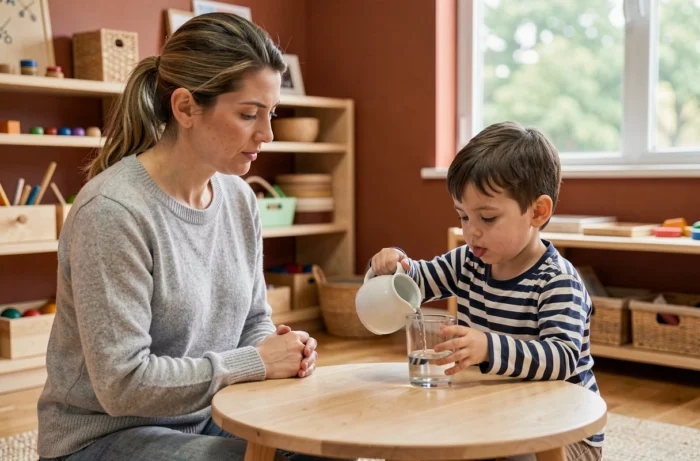
While the regulatory framework increasingly fine-tunes collective care, the home remains a space where benchmarks are less binding. Parents receive recommendations (health booklet, public guides), but no obligations comparable to those imposed on nurseries apply to the family home.
The issue of screens illustrates this asymmetry well. The prohibition for children under 3 years old applies to professional care settings, not the home. A child can spend their day in a nursery without any exposure to screens, only to find the television on at home in the evening.
This situation raises the question of educational consistency between the different living environments of the child. Several stakeholders in the sector advocate for strengthening support for parents, particularly through PMI visits during the first months and follow-up consultations with pediatricians.
Sleep, Nutrition, Interactions: The Fundamentals of Well-Being
Beyond screens, the well-being of young children rests on three pillars that early childhood professionals prioritize in their evaluations:
- Sleep: respecting the individual rhythms of the baby, even in a group setting, requires accessible rest areas at all times of the day
- Nutrition: dietary diversification, generally initiated around the sixth month, requires coordination between parents and the care structure
- Social interactions: contact with other children and stable adult references contributes to emotional and language development
These fundamentals are not new, but their consideration in French public policies is gaining visibility. The draft childhood code, currently under discussion, could ultimately bring together in a single text all provisions related to the rights and protection of children in France.
The articulation between scientific recommendations, the regulatory framework, and the daily practices of families remains an open challenge. Recent developments show a willingness to align, but the concrete translation of these texts into the daily lives of children still largely depends on the human and financial resources mobilized on the ground.