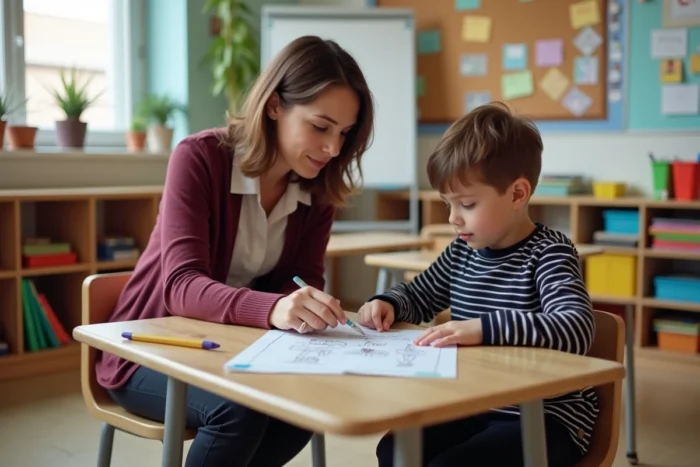
The ULIS classes (localized units for school inclusion) welcome students with disabilities within mainstream schools. The system is based on a simple principle: each child is enrolled in a reference class and occasionally joins an adapted grouping, supervised by a specialized teacher. Behind this regulatory framework, feedback from the field paints a more nuanced picture than the official texts suggest.
School demographic shock and ULIS system: a map being redrawn
Most analyses on the advantages and limitations of ULIS start from the assumption that the system remains stable and available. The reality is different. The Ministry of National Education anticipates a decline of about one million students by 2029 in French schools, due to a marked demographic drop.
This contraction has direct consequences on the school network. Class closures and restructuring of systems are already underway in several academies. When a school loses students, ULIS groupings may find themselves absorbed, relocated, or shared between institutions.
For families, this means that a ULIS orientation validated by the MDPH does not necessarily guarantee a place close to home. The opinions of specialists on ULIS classes regularly highlight this gap between the right to inclusion and the geographical reality of available places.

Training of ULIS coordinating teachers: what changes from 2026
A ULIS coordinator is not an ordinary teacher. They must first pass the school teacher competition, then obtain a specific certification as a specialized teacher. This dual pathway conditions the quality of support provided to students.
The reform of recruitment and initial training of teachers, effective from the 2026 school year, introduces new access routes. The school teacher licenses (LPE) and master’s degrees in teaching and education (M2E) restructure the training pathway. A special external competition for LPE is planned from 2028.
This enhanced professionalization of the pool of teachers likely to work in ULIS is a positive signal. However, feedback from the field diverges on one point: training more teachers does not solve the issue of the number of positions available or the attractiveness of these roles. Several teachers’ unions point out a persistent gap between the needs of inclusive systems and the actual human resources deployed.
What this reform does not address
The specialized certification remains a post-competition complement. A newly tenured teacher may find themselves assigned to a ULIS position without having obtained it yet. Families do not always have access to information about the qualification level of the coordinator who supports their child.
ULIS school inclusion: the gap between text and reality
The founding principle of ULIS is that the child remains a student in their ordinary class. They join the ULIS grouping to work on certain subjects in an adapted manner, then return to their reference class for collective times. This back-and-forth is supposed to promote learning and socialization.
Several factors nuance this scheme:
- The coordination between the ordinary class teacher and the ULIS coordinator varies significantly from one institution to another. Without dedicated time for consultation, pedagogical objectives may diverge.
- The number of students assigned to the same ULIS system tends to increase, which reduces the individual time the coordinator can devote to each path.
- Support from an AESH (accompanying student with disabilities) is not systematic, and the hours notified by the MDPH do not always correspond to the hours actually provided.
These discrepancies do not undermine the principle of the system. They show that the quality of a ULIS largely depends on the local team and the resources allocated by the academy.

School pathway after ULIS: what concrete prospects
The orientation towards a ULIS in elementary school or middle school naturally raises the question of what comes next. The ULIS-middle school system can lead to several pathways, but the available data do not allow for a uniform picture.
Some students join a SEGPA, others move towards a vocational high school with adapted support. Pathways to general high school remain rare, not due to regulatory impossibility, but because concrete bridges often lack.
A point frequently mentioned in parents’ testimonies is that the transition from ULIS-school to ULIS-middle school generally goes better than the transition from middle school to the next stage. In middle school, the coordinator has known the student for several years. At the time of transition to high school or training, the student changes interlocutors and sometimes the logic of support.
Cooperation between schools and medico-social structures
Experiments in cooperation between the National Education and medico-social establishments and services (ESMS) exist in several regions. These hybrid systems allow the student to benefit from therapeutic support integrated with their school schedule. Feedback from the field on these cooperations is encouraging, but their generalization remains limited by funding and territorial management issues.
The decision to direct a child towards a ULIS should be evaluated not as a definitive choice, but as a step in a pathway that requires regular adjustments. The system offers a structuring framework for adapted learning, provided that the teaching team, the AESH, and the family maintain regular dialogue about the objectives and limits observed throughout the school year.