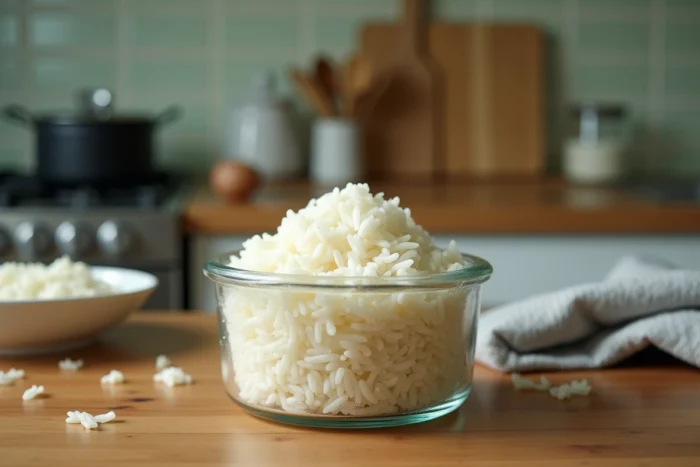
The fried rice syndrome refers to a food poisoning caused by Bacillus cereus, a bacterium capable of producing toxins in cooked starchy foods that are left at room temperature for too long. Rice is the food most often associated with this syndrome, but pasta, semolina, and potatoes present the same risk.
Slow cooling of starchy foods: the seemingly innocuous act that triggers the risk
The scene repeats itself in most kitchens: after cooking, the rice remains in the pot on the countertop while the meal finishes or the dish “cools before going into the fridge.” This waiting time, sometimes one to two hours, constitutes the critical window.
Bacillus cereus multiplies between 4 °C and 55 °C. In this range, every minute counts. The bacterium, present in spore form in raw rice, survives cooking. Once the rice is cooked and warm, the spores germinate, the bacteria proliferate, and they begin to produce toxins.
Understanding the causes of fried rice syndrome helps realize that the problem lies neither during cooking nor during reheating, but in the in-between where the dish stagnates at room temperature.
Batch cooking of starchy foods for the week amplifies this phenomenon. Preparing a large quantity of rice or pasta on Sunday, letting it cool in a bowl while the rest of the meal is put away, and then storing it in the refrigerator for several days: each step extends the time spent in the temperature range favorable to Bacillus cereus.

Emetic toxin of Bacillus cereus: why reheating is not enough
Many people think that a trip through the microwave or pan “kills the bacteria” and makes the food safe. This logic works for some pathogens, but not for fried rice syndrome.
Bacillus cereus produces two types of toxins. The first, known as diarrheal, is heat-sensitive and forms in the intestine after ingestion. The second, the emetic toxin (cereulide), is produced directly in the food before consumption. This toxin resists heat, acids, and digestive enzymes.
In practical terms, if the rice has been left at room temperature for several hours and cereulide has accumulated, no cooking method will eliminate it. Even if the dish is piping hot, the toxin remains intact and active. Reheating does not rectify prior poor storage.
Emetic syndrome and diarrheal syndrome
The two forms of poisoning related to Bacillus cereus do not manifest in the same way:
- The emetic syndrome appears quickly after ingestion, with nausea and vomiting. It is linked to cereulide preformed in the food, often in rice or pasta.
- The diarrheal syndrome occurs later, with abdominal pain and diarrhea. The toxins are produced in the intestine after eating the contaminated food.
- The majority of cases progress favorably within a few hours, but severe forms requiring hospitalization exist, particularly among vulnerable individuals.
ANSES indicates that Bacillus cereus is the main cause of bacterial foodborne outbreaks in France, accounting for about a quarter of reported cases.
Foods affected beyond fried rice
The name “fried rice syndrome” is misleading. It suggests that only fried or Cantonese rice is problematic. Bacillus cereus develops in all starchy foods once cooked and kept at inappropriate temperatures.
- Cooked pasta kept at room temperature presents the same risk. The widely reported case of a young man who died after consuming pasta left out for several days, reported in the Journal of Clinical Microbiology, specifically involved this scenario.
- Couscous semolina, often prepared in large quantities and left covered on the countertop, falls into the same category.
- Purees and potato-based preparations, batch-cooked vegetables, and certain cereal-based preparations are also favorable environments for the proliferation of Bacillus cereus.
Any cooked starchy food left between 4 °C and 55 °C promotes the growth of Bacillus cereus, regardless of the recipe.

Storage and prevention: the actions that block toxin production
Prevention is based on a simple principle: minimize the time spent in the critical temperature zone. Waiting for the dish to be “at room temperature” before putting it in the fridge is precisely the reflex to correct.
After cooking, rice or pasta should be divided into small portions in shallow containers. This distribution accelerates cooling. The containers go into the refrigerator as soon as the steam decreases, without waiting for the dish to cool.
Refrigerator storage duration
Properly cooled cooked rice can be stored in the refrigerator for a limited time. Beyond that, even in the cold, bacterial multiplication slowly resumes. Consuming leftover starchy foods quickly remains the most reliable rule.
Reheating should be thorough and even. A dish reheated to lukewarm in the center of the bowl, typical of a microwave on medium power, leaves areas where the temperature remains in the range favorable to bacteria. Stirring halfway through cooking and ensuring that the entire dish is hot limits this risk.
The spores of Bacillus cereus survive the initial cooking and cannot be eliminated by common household practices. The only controllable variable remains the time between cooking and cooling. Shortening this delay is the most effective preventive measure against fried rice syndrome, much more than the choice of reheating method.