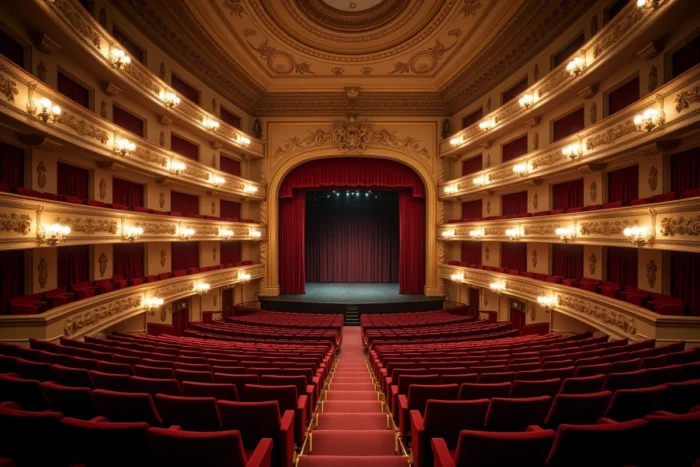
The Palais-Royal Theatre, an Italian-style auditorium nestled in the heart of Paris, has just over 700 seats spread across three levels. Between the orchestra, the balcony, and the boxes, choosing a seat involves much more than just the budget: the angle of view, proximity to the stage, and comfort vary greatly from one category to another. Understanding the geometry of this venue allows for an informed choice, show by show.
Pricing grid by category: what the price really reflects
The prices at the Palais-Royal Theatre fluctuate depending on the play being performed. Two recent examples illustrate the range of differences.
| Show | Lowest Price | Highest Price | Difference |
|---|---|---|---|
| Edmond | €16.50 | €73.50 | x 4.5 |
| Du Charbon dans les Veines | €20 | €59 | x 3 |
For a hit like Edmond, the multiplier between the cheapest category and the first category exceeds four. For a more recent production, the gap narrows significantly. This difference means that a mid-range seat offers a much better price/visibility ratio for certain plays than for others.
In practical terms, aiming for the second or third category for a high-demand comedy remains a reasonable compromise. For a less popular show, the first category becomes accessible at a price close to what one would pay for mid-range seats elsewhere.
A comprehensive guide detailing the best seat at the Palais-Royal Theatre according to Les Voyageurs confirms that the pricing structure varies greatly from one production to another.

Orchestra of the Palais-Royal: rows to favor and areas to avoid
The orchestra contains the majority of the seats and the greatest diversity of views. In an Italian-style auditorium of this size, the front rows place the spectator very close to the actors, enhancing immersion. However, the downside is a low-angle view that can obscure part of the set above.
The central rows, the most sought-after area
The rows located between the fourth and eighth rows offer the best compromise between closeness and distance. The view encompasses the stage effortlessly, the actors’ expressions remain visible, and the set appears in its entirety.
The central seats in the orchestra remain the first choice for visibility. The side seats in these same rows retain a good view, but the angle begins to close beyond the tenth seat from the center.
The last rows of the orchestra
The most distant rows are found under the overhang of the balcony. This overhang reduces the available visual height and can obscure the upper part of the stage in certain productions. For a play performed in a low set, this flaw remains minor. For a show with high scenic elements, it becomes problematic.
Balcony and side boxes: acoustic and visual compromise
The balcony of the Palais-Royal Theatre overlooks the orchestra with a steep slope. The first rows of the balcony offer a complete overhead view of the stage, without obstruction. The acoustics are often perceived as more homogeneous here, as sound travels upward in an Italian-style auditorium.
In contrast, the side boxes, located on the sides of the auditorium, impose a diagonal angle. From a side box, part of the stage may be obscured, particularly the opposite edge of the stage. This flaw varies depending on the set configuration: a centered staging compensates for it, while a set design that uses the full width of the stage makes it problematic.
- Central balcony, rows A to C: unobstructed view, moderate overhang, good price/visibility compromise
- Side balcony: increasing diagonal angle, suitable if the budget is limited
- Side boxes: historical charm, but partial visibility depending on the staging
- Front boxes (when available): frontal view comparable to the orchestra, with a slight additional distance
Offer for under-26s at €10: a unique placement strategy
The Palais-Royal Theatre offers a €10 offer for under-26s, valid only on Tuesdays, Wednesdays, and Thursdays, excluding school holidays. Tickets are sold on-site, one hour before the performance.
This price changes the usual choice logic. The remaining seats one hour before curtain time often correspond to medium or high categories that regular audiences have not purchased for that specific date. A spectator under 26 can therefore access a central orchestra seat or first balcony seat for a fraction of the displayed price.
Arriving early on a Tuesday or Wednesday maximizes the chances of obtaining a first-category seat for €10. On Thursdays, attendance is slightly higher, and the remaining choices tend to diminish.
Accessibility of the venue: a constraint to consider before booking
The Palais-Royal Theatre is not accessible to wheelchair users. The historic architecture of the building does not allow for the installation of suitable access. This information, rarely highlighted on ticketing platforms, conditions the choice of venue for spectators with reduced mobility.
For individuals who have difficulty climbing stairs but are not in a wheelchair, orchestra seats near the side access remain the least constraining solution. The balcony and high boxes require climbing narrow stairs, typical of 19th-century Parisian theatres.
The choice of a seat at the Palais-Royal Theatre hinges on three parameters: the show being performed (which determines the pricing grid and the set design), the level of the auditorium (orchestra, balcony, boxes), and personal mobility constraints. Cross-referencing these three data points before booking avoids unpleasant surprises once in the red seat.