
Converting centiliters to milliliters relies on a single operation: multiplying by 10. For 50 cl, the result is 500 ml, or half a liter. The formula poses no difficulty on paper. Errors occur elsewhere, in reading the measuring cup, in confusing units in a poorly written recipe, or in the absence of reliable visual cues in the kitchen.
Conversion table cl to ml: the most commonly used volumes in cooking
Before detailing the sources of error, a reference table covers the common conversions encountered in recipes, on cream or milk packaging, and on water bottles.
| Centiliters (cl) | Milliliters (ml) | Common equivalent |
|---|---|---|
| 5 cl | 50 ml | A liqueur glass |
| 10 cl | 100 ml | A small glass |
| 20 cl | 200 ml | A standard glass |
| 25 cl | 250 ml | A quarter liter |
| 33 cl | 330 ml | A can |
| 50 cl | 500 ml | A half liter (regular water bottle) |
| 75 cl | 750 ml | A bottle of wine |
| 100 cl | 1,000 ml | A liter |
The “common equivalent” column provides a concrete visual reference. Associating a volume with an everyday object remains the quickest way to verify a measurement without instruments.
To convert 50 centiliters to milliliters with certainty, the calculation alone is not always sufficient: one must also ensure that the volume reading is reliable.
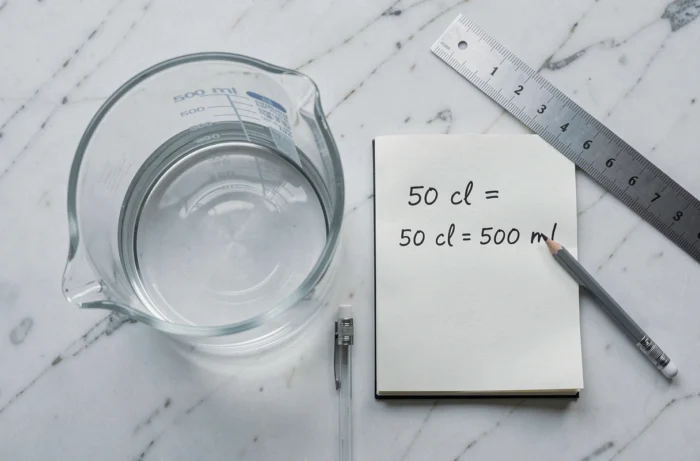
Parallax error on the measuring cup: the true source of inaccuracy
The formula ml = cl x 10 is clear. In practice, the error almost never comes from the calculation. It arises from how one reads the graduation on a measuring cup or kitchen cylinder.
The Striana website details a well-known phenomenon in metrology: parallax distorts the reading if the eyes are not level with the liquid. Looking at the measuring cup from above gives a higher value than the actual value. Looking from below underestimates it.
Conditions for a reliable measurement
- Place the measuring cup on a flat and stable surface, never held in hand at arm’s length.
- Bring the eyes exactly to the level of the targeted graduation, not above or below.
- Read the bottom of the meniscus (the curve formed by the liquid against the wall of the cup), not the top of this curve.
For a volume of 500 ml, a parallax error can shift the reading by several tens of milliliters. In a baking recipe where the proportion of liquid determines the final texture, this discrepancy is enough to ruin a cake batter or result in a cream that is too runny.
Confusion between cl and ml in recipes: an error that divides the quantity by ten
An article from Goûts et Passions dedicated to dosage errors highlights a recurring trap: confusing “40 cl” with “40 ml” amounts to dividing the quantity by ten. The result is a sauce without consistency, a cake that is too dry, or a pancake batter that is impossible to pour.
This confusion affects amateur cooks who switch from a recipe written in centiliters to another in milliliters. Some recipe websites mix the two units in the same text, indicating, for example, “25 cl of milk” followed by “100 ml of cream” without reminding of the equivalence.
How to spot and avoid confusion
The simplest reflex is to convert all measurements into a single unit before starting. If the recipe mentions 50 cl, mentally write down 500 ml. If it indicates 100 ml, know that this corresponds to 10 cl.
In case of doubt about a quantity that seems abnormally low (40 ml of milk for an entire cake, for example), check if the author meant to write 40 cl, or 400 ml. This simple consistency check avoids most mishaps.

Measuring 50 cl without a measuring cup: concrete references
Not all kitchens have a graduated cup. Several everyday objects can provide a volume of 500 ml with sufficient precision for most recipes.
- A 50 cl water bottle, filled to the brim, contains exactly the desired volume. This is the most reliable reference without a measuring instrument.
- A large water glass generally holds between 20 and 25 cl. Two large glasses filled provide a correct approximation.
- A tablespoon holds about 1.5 cl. It would take more than thirty tablespoons to reach 50 cl, making this method impractical but useful for very small adjustments.
For baking, where precision is more critical than for soup, a kitchen scale set to grams offers a reliable alternative. For pure water, 500 ml corresponds to 500 grams. This equivalence only works with water: oil, milk, or cream have different densities.
When the conversion cl to ml changes depending on the liquid measured
The conversion 50 cl = 500 ml remains valid regardless of the liquid. The volume does not change. However, the weight associated with this volume varies according to the density of the liquid.
A half liter of olive oil weighs less than a half liter of water. A half liter of thick cream weighs a bit more. If a recipe gives a quantity in grams and you measure in milliliters (or vice versa), the volume-weight conversion requires knowing the density of the liquid.
For water and aqueous liquids (broth, vinegar, lemon juice), the approximation 1 ml = 1 g works. For oil, liquid flour, or honey, this approximation no longer holds. The cl/ml conversion table remains accurate, but it does not replace a scale when the recipe is based on weight.
The conversion of 50 cl to 500 ml requires only a multiplication by 10. The real errors occur upstream, during the reading of the measuring cup or the confusion between units in a recipe. Placing the container flat, reading at the level of the meniscus, and checking the consistency of the quantities before starting is enough to eliminate almost all dosage mishaps.