
Choosing your kitchen equipment often means sifting through endless lists of utensils presented as essential. The result: cluttered cabinets, a scattered budget, and accessories that are only used once a quarter. A more effective approach is to start with what you actually cook, then select the tools suited to those specific uses.
Starting from the menu to choose your kitchen equipment
Recent guides on professional equipment, notably those from Afflec and Tableview, converge on one point: the most reliable method for equipping yourself well is to define your dishes before buying your utensils. A cook who primarily prepares stir-fries, sautéed dishes, and grilled foods has different needs than a baking enthusiast or someone who enjoys slow cooking.
Specifically, list your ten most frequent recipes. Identify the repetitive tasks (slicing, searing, blending, baking) and the dominant cooking methods. This personal mapping allows you to invest in what matters and avoid duplicates. A wok can sometimes replace a sauté pan and a frying pan, provided your heat source allows it.
To delve deeper into this targeted purchasing logic, the equipment offered on Conseils Cuisine categorizes utensils by use rather than by category, which simplifies decision-making.
Stainless steel, cast iron, or non-stick: a comparison of cooking materials
The choice of material determines the durability, versatility, and maintenance of your cookware. Here is a synthetic comparison of the three main families used by professional and home cooks alike.
| Material | Thermal conductivity | Durability | Maintenance | Preferred use |
|---|---|---|---|---|
| Stainless steel | Medium (often multi-layered base) | Very high | Easy, dishwasher compatible | Sauces, deglazing, browning |
| Cast iron (raw or enameled) | Slow but very even | Almost unlimited | Immediate drying, regular seasoning (raw cast iron) | Stews, slow cooking, bread |
| Non-stick (PTFE or ceramic) | Good | Limited (replacement every 2-3 years with heavy use) | Very easy, non-metal utensils required | Eggs, pancakes, delicate cooking |
Stainless steel dominates professional kitchens because it withstands high temperatures without degrading and allows for deglazing, a central technique for sauces. However, it requires a heating time and the addition of fat to prevent food from sticking.
Cast iron excels in long cooking. Its substantial mass stores heat and releases it evenly, making it the reference material for braised meats or oven casseroles. Its weight is its main limitation in daily use.
Non-stick remains the most practical choice for quick cooking with low fat. However, its reduced lifespan means it should be considered a consumable rather than a long-term investment.
Chef’s knife and cutlery: quality of cut versus quantity of blades
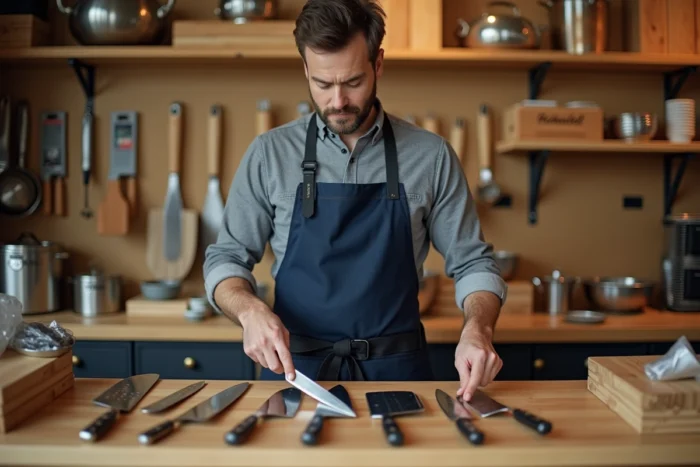
Philippe Etchebest reminds us in his equipment guide: three quality knives are enough to cover almost all cutting needs. The instinct to buy a block of twelve blades often leads to accumulating mediocre knives, half of which never leave the drawer.
The three blades that cover the majority of needs:
- A chef’s knife (wide blade, versatile for slicing, chopping, mincing herbs, and cutting meat)
- A paring knife (small blade for precision tasks, peeling, and small vegetables)
- A bread knife or a filleting knife depending on your habits (the former for hard crusts, the latter for filleting fish)
The steel of the blade determines the sharpness retention. High-carbon steel retains its edge longer than standard stainless steel, but it requires regular maintenance with a honing steel. A knife that cuts well reduces the risk of injury, as accidents happen when forcing a dull blade.

Small appliances: distinguishing the useful from the gadget in the kitchen
The market for small appliances is filled with specialized devices. Before investing, apply a simple filter: does this appliance replace at least two manual tasks you perform each week?
An immersion blender easily passes this test. It replaces the blender for soups, serves as an electric whisk with the appropriate attachment, and allows for quick chopping. In contrast, an electric pasta machine is only justified if you make fresh pasta at least twice a month.
- A food processor is suitable for cooks who knead, slice, and blend regularly, but it takes up significant counter space
- A kitchen scale (electronic, gram precision) is a low-cost purchase that improves the consistency of results, especially in baking
- A probe thermometer allows you to control the cooking of meat without cutting into it to check, an underestimated accessory that changes the precision of the result
The most reliable criterion remains the availability of spare parts. An appliance whose bowl, blade, or seal can no longer be found after two years ends up in the trash. Check the availability duration of parts before purchasing.
Kitchen equipment budget: plan for a second wave of purchases
Field feedback shows that a significant portion of the equipment budget is spent after the first weeks of actual use. You then discover that an additional cutting board, a medium-sized mixing bowl, or vertical storage for lids is missing.
Setting aside a budget margin for these adjustments prevents cutting corners on the quality of the initial purchases. It’s better to start with fewer pieces, all chosen for their durability, and to supplement as real needs arise rather than buying a complete set half of which will be replaced within the year.
The mixed approach of new and second-hand should also be considered. Simple mechanical utensils (stainless steel pots, baking dishes, steel molds) can easily be found second-hand in good condition. Electrical appliances, on the other hand, are better purchased new to benefit from the warranty and access to spare parts.