
A high-performing home workshop is not built by stacking references. It is built by selecting tools whose technical characteristics match the actual tasks being performed. We recommend reasoning by task family before reasoning by tool category, which avoids redundant purchases and critical gaps during a project.
Torque and battery platform: the real criteria for choosing a drill-driver
The drill-driver is the pivot of any home workshop. The distinguishing parameter is not the brand, but the torque expressed in newton-meters. A model intended for assembling flat-pack furniture does not need the same torque as a device designed to drill through cellular concrete or to fix anchors in concrete blocks.
We observe a common mistake: buying a low-torque drill-driver, then having to invest in a hammer drill a few months later. For most interior renovation tasks, a device offering sufficient torque in screw mode and a hammer function covers the majority of needs.
The choice of the battery platform conditions the rest of the equipment. Major manufacturers offer ranges where the same battery powers a drill, jigsaw, sander, and grinder. Choosing a platform compatible with multiple tools from the start reduces overall costs and simplifies storage. To identify the equipment offered on Mulot Bricole, we recommend checking inter-tool compatibility before any individual purchase.

Hand tools: selection by function rather than by generic list
Competing articles roll out a standard list (hammer, screwdriver, pliers, tape measure). This approach encourages accumulation without prioritization. Five well-chosen hand tools cover almost all common interventions in a home.
Striking and leverage
A carpenter’s hammer with a composite handle absorbs vibrations better than a traditional wooden handle. The head should be forged, not cast. A short crowbar complements this section for dismantling paneling, baseboards, or pallets.
Screwing and manual tightening
A set of screwdrivers covering Pozidriv, Phillips, and Torx profiles is sufficient for the majority of screws encountered in homes. Interchangeable bits on a magnetic bit holder effectively replace a dozen individual screwdrivers. For tightening, a ratchet adjustable wrench and a slip joint pliers handle plumbing fittings and common nuts.
Measuring and marking
A class II tape measure and a spirit level form the foundation for any precise intervention. The laser level, often presented as a gadget, quickly becomes cost-effective once more than two shelves are installed or when marking points on multiple walls.
Protective equipment: a priority purchase, not optional
Several recent sources emphasize that protective equipment should be purchased and stored in the toolbox with the same priority as the hammer or drill. This approach changes the investment logic.
Here are the protections to integrate from the outset of the workshop:
- Wide-branch safety glasses, essential whenever drilling, grinding, or sawing, including for brief interventions where projections remain probable.
- Gloves fitted to hand size, made of cut-resistant material for handling sheets and glass, and soft leather for manual handling tasks.
- FFP2 dust mask for sanding, cutting plasterboard, and any operation generating fine particles.
- Hearing protection (molded earplugs or noise-canceling headphones) as soon as using a circular saw, grinder, or hammer drill.
These items represent a modest budget compared to the cost of a power tool, but their absence exposes one to real and immediate risks.
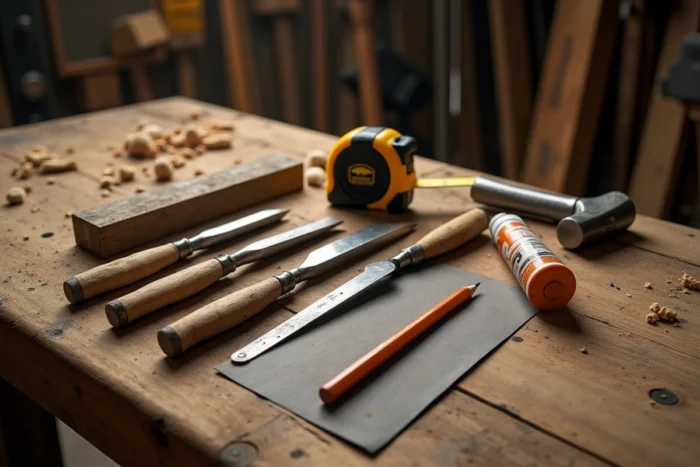
Jigsaw and sander: two power tools that change the quality of finishes
After the drill-driver, the jigsaw is the second power tool to acquire. It cuts wood, melamine, PVC, and, with the right blade, some thin metals. The cutting depth and speed control determine the actual versatility of the device.
The vibrating or orbital sander is involved in all renovation tasks: stripping a piece of furniture, preparing a surface before painting, finishing a countertop. An orbital model offers a better compromise between material removal and surface quality than a rectangular vibrating sander.
If the battery platform chosen for the drill-driver offers these two tools in a compatible version, the investment becomes coherent. Otherwise, corded models remain relevant for home use, with the advantage of constant power without autonomy limits.
Storage and organization of the DIY workshop
A poorly stored tool is a tool that cannot be found at the critical moment. Vertical storage on a pegboard frees up the work surface and provides immediate visibility of the available inventory.
We recommend physically separating three areas in the workshop:
- Wall storage area for hand tools and the most used accessories, accessible without opening a drawer.
- Closed storage area (chest or cart) for power tools, their chargers, and spare batteries.
- Clear work area, with a stable workbench whose surface withstands shocks and scratches without structural damage.
This organization reduces preparation time before each intervention and limits the risk of heavy tools falling from a cluttered shelf.
Building a reliable home workshop relies on three concrete trade-offs: the compatibility of the battery platform, the quality of personal protective equipment, and storage that makes each tool accessible in seconds. The rest can be completed over time with ongoing projects, without urgency.