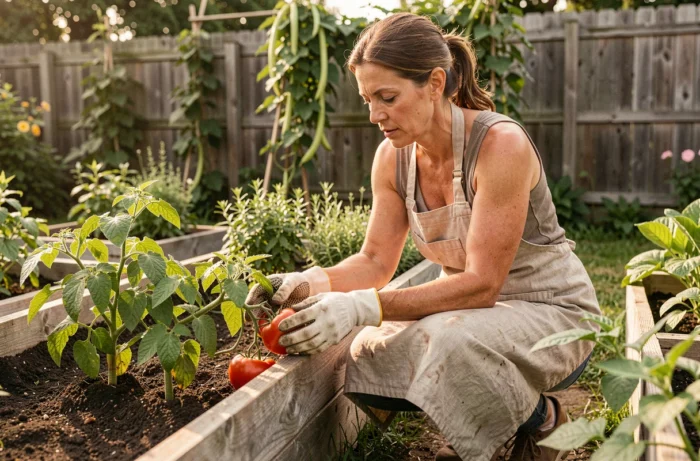
A bio vegetable garden that produces year-round is based on a principle often underestimated: the soil nourishes the plant, not the other way around. Before choosing seeds or laying out planting beds, the fertility of the soil conditions every upcoming harvest. Understanding this mechanism, and then organizing the sowing to cover the four seasons, allows for a consistent production without resorting to synthetic chemical inputs.
Copper and biocontrol: what the regulations change for the organic vegetable garden
Organic gardening is not limited to avoiding pesticides. It operates within a regulatory framework that is evolving and directly impacts the products available in garden centers.
Copper, for example, remains permitted in organic farming in Europe, but under a strict ceiling. According to a note published in August 2026, a maximum of 28 kg of pure copper per hectare can be used over a given period, with an annual average of 4 kg over 7 years.
For a vegetable garden of a few square meters, these thresholds are rarely reached. However, the logic of multi-year smoothing is worth knowing: a massive copper treatment in one year reduces the margin for the following years.
On the biocontrol solutions side, the legal category is progressing in European law. The Omnibus X proposal introduces for the first time categories of “substances” and “products” of biocontrol, with a lighter framework compared to conventional pesticides.
In practical terms, new preparations based on microorganisms or plant extracts could come to market more quickly. To explore the alternatives currently available, you can discover the vegetable garden on Jardinage Bio.
Soil fertility in the organic vegetable garden: compost, mulching, and microbial life
A fertile organic soil is a living soil. The difference with simply “amended” soil lies in the active presence of microorganisms, mycorrhizal fungi, and earthworms that decompose organic matter and make nutrients assimilable by the roots.
Building fertility with compost
Compost remains the cornerstone of natural fertilization in the vegetable garden. Mixing green waste (peelings, clippings) and brown waste (dead leaves, unprinted cardboard) in a balanced ratio produces a rich amendment in a few months. The application is preferably done in autumn, in a thick layer on the planting beds, to allow the soil fauna to incorporate it during the winter.
Permanent mulching: protecting and nourishing at the same time
A bare soil is a degrading soil. Mulching serves two simultaneous functions: limiting water evaporation and gradually nourishing the soil as it decomposes. Cereal straw, hay, wood chips, dead leaves – each material has a different carbon/nitrogen ratio that influences the decomposition rate.
- Wood chips are suitable for pathways and the bases of fruit trees, as they decompose slowly and can cause a temporary nitrogen hunger in annual crops.
- Cereal straw or hay is suitable for vegetable beds, with a sufficient thickness to block the emergence of weeds.
- Dead leaves, free and abundant in autumn, form an ideal light mulch for early spring sowings.
The goal is to never leave the soil bare between two crops. Even a sowing of green manure (mustard, phacelia, clover) fulfills this role during the lean periods.
Staggering sowings to harvest from the organic vegetable garden all year round
Producing continuously does not require a large area. It is the planning of sowings that determines the continuity of harvests, not the size of the land. The principle relies on two levers: staggering sowing dates and choosing varieties suited to each season.
Staggered sowings: the relay technique
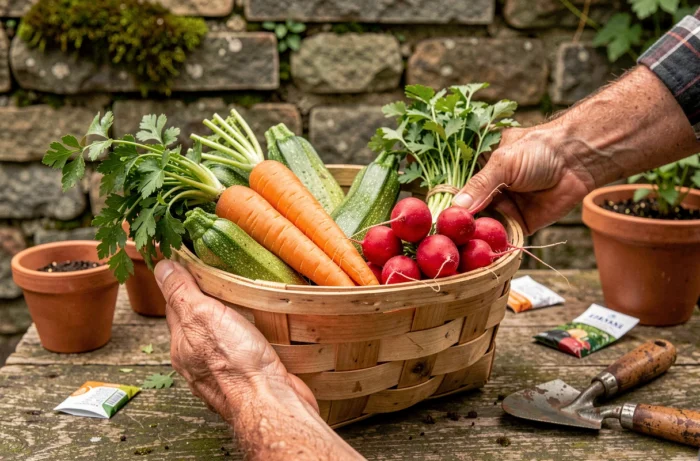
Instead of sowing an entire row of radishes or lettuce all at once, spacing the sowings by two to three weeks spreads the production over several months. This staggering avoids harvest peaks that are impossible to consume and lean periods with nothing to pick.
For tomatoes, zucchinis, or beans, the same reasoning applies with longer intervals, depending on the vegetative cycle of each species.
Winter and late-season crops
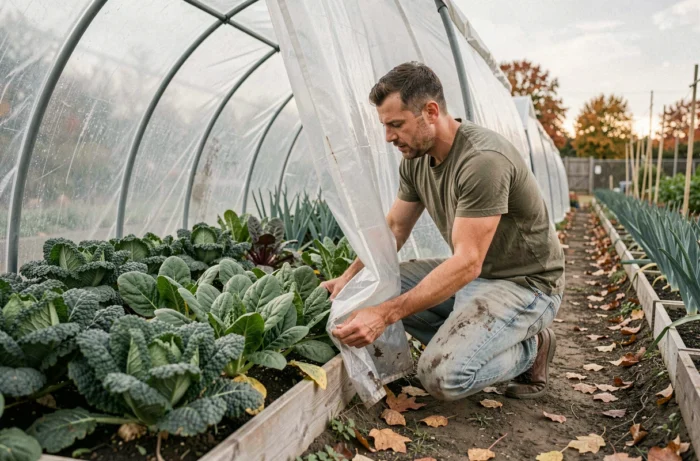
Harvesting year-round means not abandoning the vegetable garden after the first frosts. Lamb’s lettuce, spinach, leeks, and cabbages withstand the cold and can be harvested from November to March in most French regions. The sowing of these vegetables takes place between July and September, a window often forgotten because it coincides with peak summer production.
A winter cover or a cold frame is enough to extend the season for some fragile crops. These simple protections allow for several weeks of harvest without heating or expensive greenhouses.
Crop associations and layers of vegetation in the organic vegetable garden
Growing multiple species on the same bed increases production per square meter and limits pest pressure. The principle of companion planting is based on concrete interactions between species.
Basil planted at the foot of tomatoes is not just a classic repeated without proof: the volatile compounds of basil actually disrupt certain insects. Carrots and leeks, grown in alternating rows, protect each other from their respective flies (carrot fly and leek moth).
Playing with layers of vegetation multiplies the useful space. Low leafy vegetables (lettuce, lamb’s lettuce) thrive in the partial shade of taller crops (tomatoes, pole beans). This stratification reproduces the logic of natural ecosystems and makes better use of the available light.
- Low layer: radishes, strawberries, salads, spinach.
- Intermediate layer: peppers, eggplants, cabbages.
- High layer: staked tomatoes, climbing beans, corn.
- Climbing or covering layer: sprawling squash on the ground, cucumbers on trellises.
The diversity of crops also plays a role in crop rotation: alternating botanical families from year to year on each bed reduces soil depletion and breaks the cycle of diseases specific to each family (solanaceae, brassicaceae, fabaceae).
A productive organic vegetable garden all year round depends less on the cultivated area than on the coherence between soil life, sowing planning, and the permanent occupation of space. Every bed left empty is a lost opportunity to nourish the soil or prepare the next harvest.