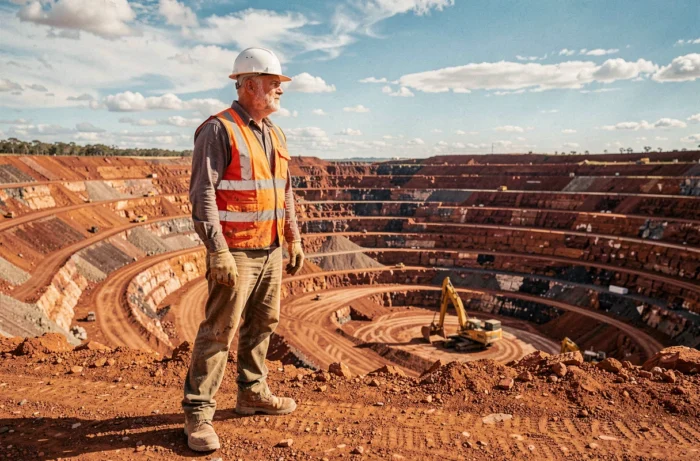
The Australian mining sector attracts thousands of candidates each year, often drawn by some of the highest salaries in the country. The real daily life of those working in a mine in Australia remains difficult to grasp from the outside: the structure of rotations, geographical isolation, and physical constraints shape a lifestyle that job descriptions do not capture.
Roster and biological rhythm: how FIFO schedules change daily life
The FIFO (Fly-In, Fly-Out) system imposes rotations between the mining site and home, sometimes located thousands of kilometers away. According to a synthesis of 59 studies reported by the Future of Work Institute and the WA Mental Health Commission, the design of the roster is a major factor in the well-being of mining workers.
Rotation formats vary. An “even-time” 2:2 roster (two weeks on site, two weeks off) is considered more sustainable than a compressed roster like 4:1 or 3:1. Rosters that include night shifts or long commutes between the airport and the site exacerbate chronic fatigue, stress, and sleep disturbances.
Specifically, each day on site begins well before descending or moving to the extraction area. The pre-start briefing, a mandatory safety meeting, lasts about fifteen minutes. Shifts generally span twelve hours, day or night, with little flexibility. Those who choose to work in a mine in Australia quickly discover that their biological clock becomes a parameter to manage just like physical safety.
Life on a mining site: between accommodation camp and social isolation
Mining camps (FIFO villages) are temporary micro-cities set up in remote areas, often in the Pilbara or Goldfields in Western Australia. Each worker has an air-conditioned individual room, called a “donga,” with a private bathroom in most recent sites.
Meals are provided in a centralized mess (wet mess or dry mess depending on the site’s alcohol policy). Facilities typically include a gym, a television room, and sometimes a pool. According to a report from recruiter MPI, companies are investing more in the comfort of camps to reduce turnover, but isolation remains the primary source of difficulty reported by employees.
Internet access, long limited, is improving, but coverage remains uneven between sites. Video calls with family often take place from the donga at the end of a shift, within a time window reduced by the time difference with the east coast.
Mental health and psychosocial prevention on sites
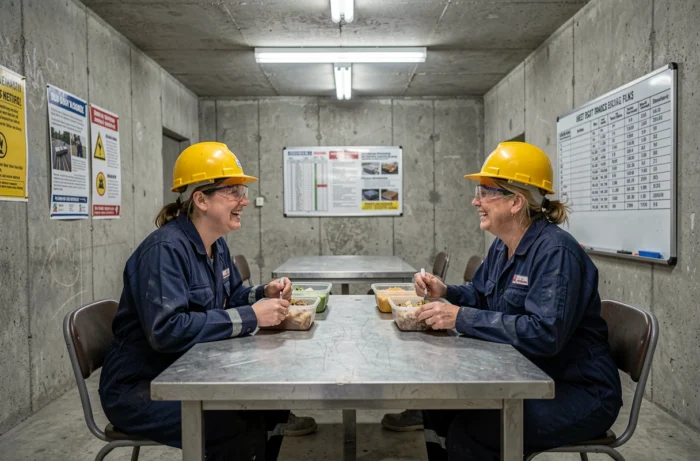
The mental health of FIFO workers is now recognized as a structured occupational risk. Some sites incorporate micro-rituals of prevention into daily routines: in the crib room (break room), during shift changes, or at pre-start, workers are explicitly invited to check on their colleagues’ well-being through initiatives like “R U OK?”.
This initiative, supported by a partnership between Nescafé and the R U OK? foundation, transforms coffee breaks into moments of psychosocial prevention rather than relying solely on occasional training. The goal is to detect signs of distress in the informal context of daily life, where workers are more open.
Working conditions by type of mine: underground vs. open-pit comparison
| Criterion | Open-pit Mine | Underground Mine |
|---|---|---|
| Climate exposure | Extreme heat, dust, UV | Stable temperature, high humidity |
| Common entry positions | Truck operator, general laborer | Loader operator, bolter |
| Required certification | White Card, HR license depending on position | White Card, specific underground training |
| Main risk | Vehicle-machine collision | Collapse, ventilation failure |
| Physical pace | Prolonged driving, vibrations | Manual labor, confined spaces |
In underground mines, recent job postings for entry-level operator positions mention rosters of 8 days on / 6 days off, only during the day. In open-pit mines, rotations are often longer, with frequent night shifts.
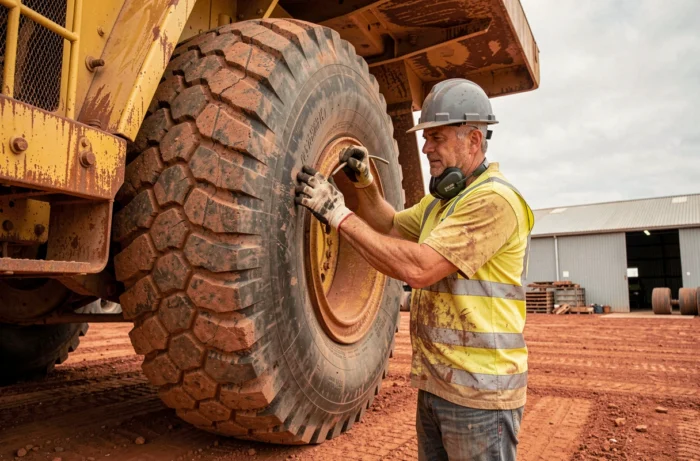
A new road safety code has been introduced in Western Australia to reduce traffic incidents on mining roads, indicating that road risk on site remains a major concern for authorities.
Absenteeism and turnover: signals of a difficult daily life
The absenteeism rate among FIFO teams is analyzed as an indicator of the sustainability of mining daily life. According to Data Informatics, specializing in workforce management in mining, chronic absenteeism at certain sites reflects a cultural as much as an organizational problem. The most documented causes include:
- Accumulated fatigue over several consecutive rotations, exacerbated by night shifts and long commutes
- Prolonged isolation, with a measurable impact on family relationships and motivation
- Mismatch between salary expectations (sometimes fueled by social media) and the physical reality of the job
Companies that manage retention best invest in workforce management software to adapt rosters to signals of fatigue, rather than applying a uniform schedule.
Compensation and the real cost of the FIFO lifestyle
Australian mining salaries remain among the highest in the global primary sector. Recent job postings for entry-level underground operator positions advertise salaries reaching AUD 160,000 per year for experienced profiles. Entry-level positions are significantly lower but still above the national average.
The actual calculation of earnings must consider several parameters rarely mentioned:
- Housing and meals on site are covered, significantly reducing daily expenses during rotations
- Maintaining rent at home during weeks of absence represents a fixed cost often underestimated
- Travel expenses to the FIFO airport are not always covered by the employer
- Physical and psychological wear can generate medium-term health costs
Daily life in mining in Australia is not just a financial trade-off. The key factor that separates those who endure multiple rotations from those who leave after a few weeks is the compatibility between the roster format and the worker’s personal life. Sites that offer “even-time” rosters only during the day show significantly better retention rates, confirming that the schedule matters as much as the salary in the viability of this career choice.