Designing an outdoor garden in 2026 involves adapting to denser plant trends, raw materials, and increasingly precise urban planning regulations. This paradigm shift changes the way every square meter of an outdoor space is considered, from the choice of flooring to vertical structures.
Outdoor flooring and materials: what the 2026 trends concretely change
The large uniform lawn area is declining. Organic and vibrant compositions, integrated into the surrounding landscape, are gaining ground in recent landscaping projects. This aesthetic shift has direct practical consequences on the choice of flooring materials.
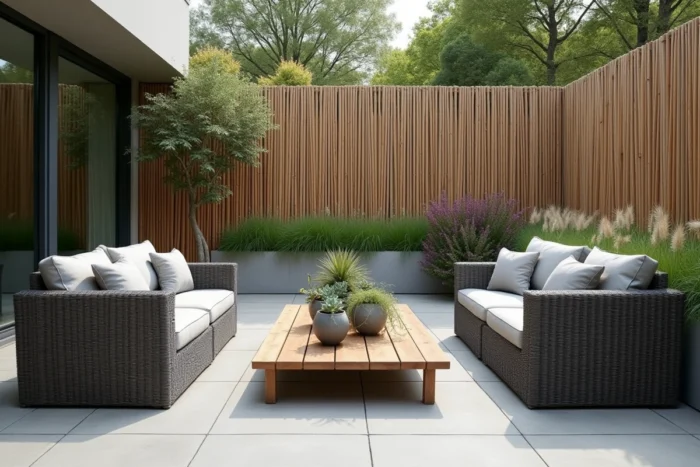
Outdoor ceramic is becoming common for uses once reserved for natural stone or composite wood: pool edges, tabletops, outdoor kitchens. At the same time, reclaimed brick pavers and small white stones are making a comeback in projects, reinterpreted in a classic yet contemporary style.
For terraces, wood remains a popular choice, but the issue of long-term maintenance is pushing many homeowners toward alternatives. Ceramic and composite slabs require less annual treatment than wood decking, which needs a brightener or saturator every year to maintain its appearance. However, wood offers superior thermal comfort barefoot in the summer, a criterion that technical sheets rarely mention.
In terms of color palettes, earthy tones, forest greens, and refined browns dominate recent projects. Blacks are also nuanced: charcoal, brown-black, green reflections for facades and outdoor structures. This evolution directly influences the choice of fences, pergolas, and garden furniture.
Browsing the presentation of the Ambiance Jardin space allows you to visualize how these materials come together in a coherent project, from flooring to structural elements.
Urban planning regulations for gardens: pitfalls to check before starting
Many outdoor landscaping projects begin without prior verification of the local urban planning plan. A mistake that can be costly since the tightening of penalties.
A recent law simplifying urban planning and housing law has introduced changes to the processing times for prior work declarations. Field feedback varies on this point: some municipalities are already applying the new timelines, while others still operate under the old schedule.
What to remember for a garden project:
- Any construction covering more than five square meters (garden shed, enclosed pergola, covered outdoor kitchen) requires at least a prior work declaration with the town hall
- Fences are subject to declaration in most municipalities, with maximum heights varying according to the PLU zones
- Soil impermeabilization (concrete terrace, solid slab) may be regulated by land coverage coefficients, which require maintaining a percentage of permeable surface on the lot
The land coverage coefficient is the most common pitfall. A terrace project that covers a large part of the garden may be denied if the remaining permeable surface falls below the threshold set by the PLU. Checking this point before choosing materials avoids having to revise the entire project afterward.
Plants and sustainable maintenance: moving beyond the catalog reflex
Plant maximalism, with its abundance of plants and marked contrasts, is the strong trend of 2026 in landscaping. The idea is appealing, but it raises a rarely addressed question: a maximalist garden requires more maintenance than a minimalist garden.
The key to preventing abundance from becoming a burden lies in the choice of species. Plants suited to the local climate and soil type require less watering, less treatment, and less replacement. Clay soil does not react like sandy soil, and the same variety can thrive in one case and wither in another.
Before selecting plants, three parameters deserve on-site analysis:
- The actual sunlight exposure of each area of the garden, measured over several days and not just estimated by eye
- The natural drainage of the soil, testable by digging a thirty-centimeter hole and observing the absorption rate after watering
- The exposure to prevailing winds, which dry out certain areas and protect others, significantly altering water needs
The creation of plant layers (ground cover, medium shrubs, canopy trees) replicates a natural ecosystem that partially self-regulates. Ground covers limit evaporation, shrubs protect from wind, and trees filter sunlight. This approach reduces long-term maintenance and improves the garden’s resilience against drought episodes.
Structuring the garden space with levels and circulation zones
A flat terrain does not condemn one to a monotonous layout. Creating levels, even slight ones (a twenty-centimeter step, a raised border), is enough to delineate spaces without resorting to fences or hedges.
Earthworks remain the most effective method for structuring a sloped garden or creating plateaus on uneven terrain. Poorly executed leveling creates lasting drainage issues, with water stagnation zones that weaken plantings and structures. This aspect of work, often underestimated in budgets, conditions the success of everything else.
For circulation, curved paths visually enlarge a small space, while straight lines are better suited for long and narrow gardens. The material of the path should be consistent with that of the terrace to avoid a patchwork effect. A stabilized gravel path is cheaper than paving, remains permeable (a plus for the land coverage coefficient), and integrates well into the organic compositions that dominate current projects.
Designing an outdoor garden space involves both technical and aesthetic considerations. The PLU, the nature of the soil, and the annual maintenance budget are three filters to apply before any style or planting decision.