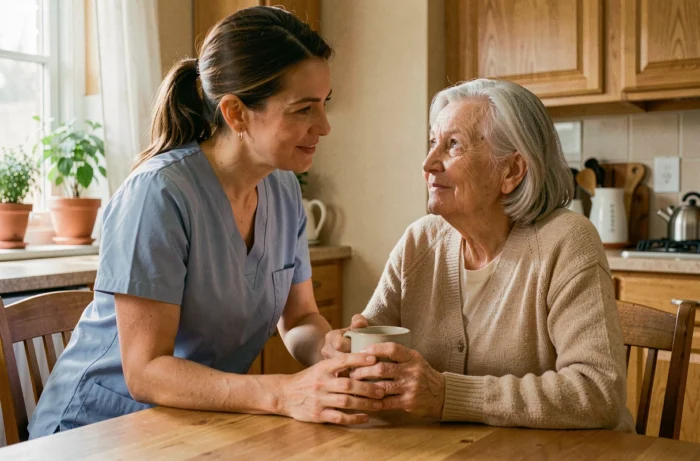
The care and support services for seniors encompass all the services that allow an elderly person to continue living at home or in an adapted place, with regular professional support. These services cover both assistance with daily activities and medical coordination, and their regulatory framework has changed significantly in recent years.
Home autonomy service: the reform that reshapes senior care offerings
The former acronyms SAAD, SSIAD, and SPASAD are gradually disappearing in favor of a single category: the home autonomy service (SAD). This reform, initiated by a decree in July 2023 and supplemented by budgetary texts in 2024, aims to simplify the journey for elderly individuals by combining daily living assistance and nursing care under one structure.
Two forms coexist. The “assistance” SAD focuses on household tasks, meal preparation, and social support. The “mixed” SAD adds coordinated nursing care, which avoids multiplying the points of contact for the elderly person and their family.
On the ground, the transition remains slow. Many services still operate under the old authorization regimes, and departments are progressing at very different rates. For families, the direct consequence is a heterogeneous landscape of offerings depending on the geographical area, where it is sometimes necessary to learn more about Soin Et Compassion and other specialized actors to identify the structures that have already converted to the new format.
Home care for seniors: what coverage really entails
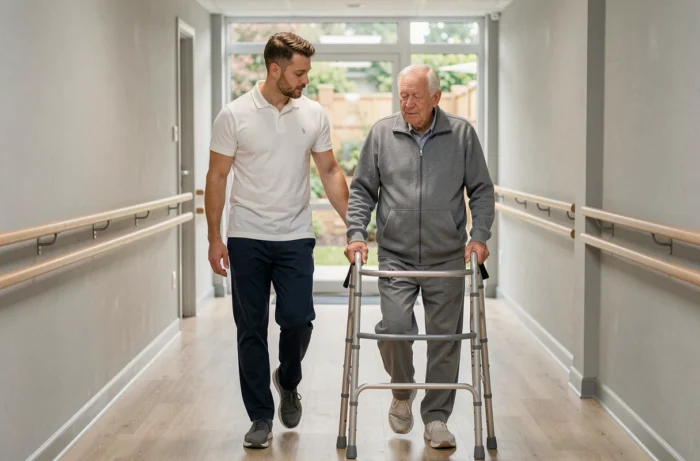
The term “home care” encompasses very different realities depending on the level of dependency. Distinguishing these levels allows for the selection of the appropriate service.
Assistance with daily living activities
This first level concerns dressing, personal hygiene, shopping, and home maintenance. The caregivers are not medical professionals. They fall under the realm of social assistance and are primarily funded by the APA (personalized autonomy allowance) at home or by departmental home help.
Nursing care and medical coordination
Home nursing care includes monitoring treatments, injections, wound care, and fall prevention. These actions are prescribed by a doctor and covered by health insurance. With the mixed SAD reform, they can now be provided by the same structure as daily assistance.
The coordination between the primary care physician, the nurse, and the home helper remains the weak point of the system. When these professionals depend on different structures, information transfers can be lost. The mixed SAD was specifically designed to reduce this risk.
Home APA and financial assistance: access declining despite needs
Data published by DREES in September 2026 reveal a counterintuitive fact: the number of beneficiaries of social home assistance for elderly individuals has decreased for the first time since 2020. This decrease affects both home APA and home help funded by social assistance from the department.
Several factors explain this decline. The application procedures remain complex, and some eligible individuals do not assert their rights. The saturation of certain services, which can no longer accept new beneficiaries due to a lack of staff, also contributes to the phenomenon.
For families, understanding the available systems is a prerequisite for any approach. Here are the main aids that can be mobilized:
- The home APA, granted by the departmental council after assessing the level of dependency (GIR 1 to 4), finances a personalized assistance plan covering home intervention hours
- The departmental home help, intended for individuals classified in GIR 5 or 6 with modest resources, covers basic domestic tasks
- The ARDH (aid for returning home after hospitalization), provided by pension funds, temporarily covers expenses related to enhanced assistance in the weeks following a hospital discharge
The amount and conditions vary by department. Two individuals with the same level of dependency may receive very different assistance plans depending on their place of residence.
Teleassistance and meal delivery: often underestimated complementary services
Beyond human assistance, two technical services enhance the safety and nutrition of seniors at home without requiring a continuous caregiver.
Teleassistance for seniors
The system relies on a connected device or bracelet that allows an alert to be triggered in case of a fall or malaise. An operator contacts the person, assesses the situation, and mobilizes emergency services if necessary. Teleassistance reduces the response time after a fall, a crucial factor in the recovery of elderly individuals.
Some departments partially subsidize the subscription. The APA can also include teleassistance in the assistance plan.
Meal delivery at home
Meal delivery ensures a regular and balanced diet for individuals who can no longer cook. The service is generally provided by associations or companies contracted by the municipality. Beyond nutrition, the daily visit from the delivery person constitutes a minimal yet regular social link, which helps to detect any deterioration in health status.
Support for caregivers: a fragile link in home care
Home care largely relies on family caregivers, who often provide the majority of daily support without training or structured assistance. Caregiver burnout is the leading cause of unwanted institutional placement.
Several systems exist to relieve caregivers:
- The right to respite, integrated into the APA since the law adapting society to aging, finances replacement hours or temporary admission to a facility
- Support and respite platforms, present in most departments, offer support groups, training, and professional listening
- Day care in specialized structures, particularly for individuals with neurodegenerative diseases, frees up a few hours per week for the primary caregiver
These systems remain underutilized. Administrative complexity and feelings of guilt hinder many caregivers. Identifying the right local contact, whether it be the CLIC (local information and coordination center) or the departmental autonomy house, remains the first concrete step to accessing these supports.
The senior care and support sector is undergoing a profound restructuring phase, between the reform of home services and the paradoxical decline in the use of aids. For families, the main difficulty is no longer the absence of systems, but their clarity and actual accessibility depending on the territory.