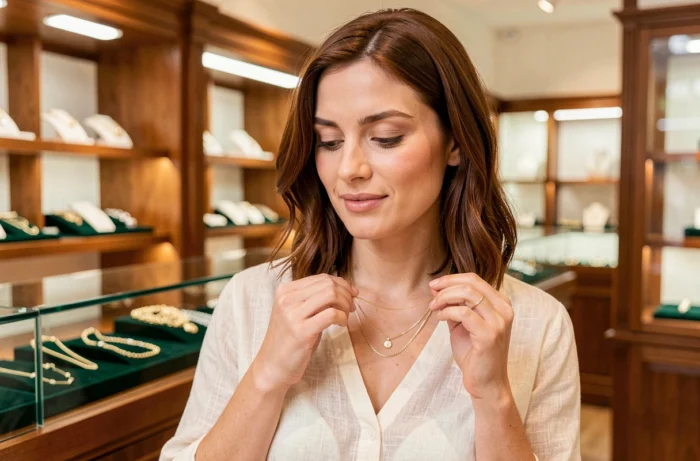
A necklace worn over a turtleneck does not have the same effect as on a bare neckline. A bold ring changes the perception of a hand depending on whether it is alone or accompanied by three others. Jewelry accessories do not just decorate an outfit; they alter its interpretation. Understanding this mechanism allows for more precise choices and the affirmation of a personal style without accumulating pieces.
Jewelry and garment proportions: the relationship no one calculates
You may have noticed that a long pendant looks elegant on a buttoned shirt but visually disappears on an oversized sweater? This discrepancy can be explained by a simple principle: each piece of jewelry interacts with the fabric surface that surrounds it.
A choker works well on a wide neckline because it creates a focal point in an open space. Placed on a high collar, it competes with the fabric and loses its visibility. The size of the jewelry is chosen based on the visible skin area, not based on the jewelry itself.
The same reasoning applies to earrings. Large hoops work when the hair is up or short. With a voluminous hairstyle, they overwhelm the facial area. Studs or short sleepers then regain the advantage.
To create an outfit where each piece enhances the others, you can browse the accessories from Magie des Bijoux and observe how formats vary from one style to another.
This principle of proportion also applies to rings. An architectural ring draws attention to the hand. If you wear long sleeves that partially cover the fingers, the jewelry will be truncated. Three-quarter or rolled-up sleeves free the wrist and hand, making the ring fully visible.
Choosing jewelry by material contrast rather than color
Most style advice emphasizes color harmony between jewelry and clothing. This is a useful guideline, but it masks a more powerful lever: material contrast.
A matte silver necklace placed on a shiny silk blouse creates visual tension. The eye shifts from the fluid fabric to the raw metal, and this alternation adds depth to the outfit. Conversely, shiny jewelry on shiny fabric produces a flat, almost monotonous effect.
Three material combinations that work
- Polished metal (gold, silver) on raw fabric (linen, thick cotton, denim): the jewelry stands out because the texture of the garment absorbs light while the metal reflects it.
- Natural stones or wood on smooth fabric (silk, satin, fine jersey): the organic appearance of the jewelry contrasts with the regularity of the fabric and adds a touch of character.
- Textured jewelry (hammered, braided) on solid colors: when the garment is simple, it is the surface of the jewelry that brings visual complexity.
Texture contrast effectively replaces the accumulation of pieces. A single hammered bracelet on a smooth sleeve is enough to transform a minimalist look.
Unique jewelry accessories: what digital co-creation changes
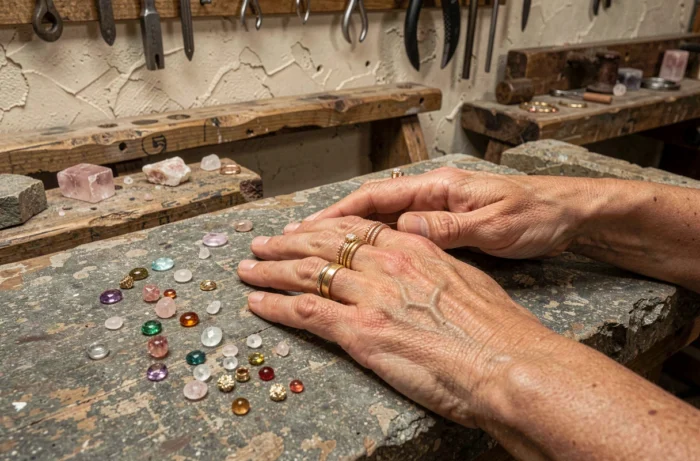
The idea of a unique piece of jewelry often evokes traditional craftsmanship, a workshop, a goldsmith. This image remains valid, but another path is rapidly developing. Several market players now offer tools for AI-assisted design that allow customers to modify shapes, stones, and engravings in real-time before production.
3D printing then comes into play to produce the piece. The result is a piece of jewelry that exists only in one copy, partly designed by the person who will wear it. This co-creation approach represents a growing share of online jewelry sales.
Why does this change the game for style? Because a co-created piece of jewelry reflects concrete choices: the thickness of a ring, the position of a stone, the length of a chain adjusted to the millimeter. A piece of jewelry designed for a specific morphology integrates better than a standard model.
What to check before co-creating jewelry online
Customization tools vary in quality. Some are limited to engraving on an existing model, while others offer real structural modification. Before you start, check that the platform provides a 3D or augmented reality visualization of the finished piece.
Also, check the mentions regarding materials. The European directive 2024/825, applicable from September 27, 2026, imposes new transparency rules on sustainability claims. Vague terms like “eco-friendly” or “sustainable jewelry” without precise justification will be prohibited. Demand concrete information about the origin of metals and stones.

Visual balance of an outfit: the rule of the unique focal point
Accumulating necklaces, rings, earrings, and bracelets in a single outfit is tempting. The result depends on one parameter: visual hierarchy.
An outfit works when the eye knows where to land first. If every piece of jewelry demands the same attention, none stands out. The principle of the unique focal point consists of choosing a single area of impact, the neck, wrist, or ears, and concentrating the most expressive piece there.
The other areas receive discreet jewelry, or nothing at all. This is not minimalism; it is composition. A statement necklace silences the earrings. Large hoops require a bare neck or a simple fine choker.
- Statement necklace: pair it with stud earrings and no visible bracelet.
- Long earrings: free the neck, possibly wear a fine ring to balance the bottom.
- Wide cuff or bracelet: leave the hands without a bold ring and keep the upper body clean.
This principle adapts to all occasions. An evening outfit does not require more jewelry than a daily look; it requires a better-defined focal point.
The choice of unique jewelry accessories gains impact when it is based on these visual mechanics. A well-placed piece in the outfit, at the right scale, contrasting with the fabric and alone in its area, produces an effect that ten poorly distributed pieces will not achieve.