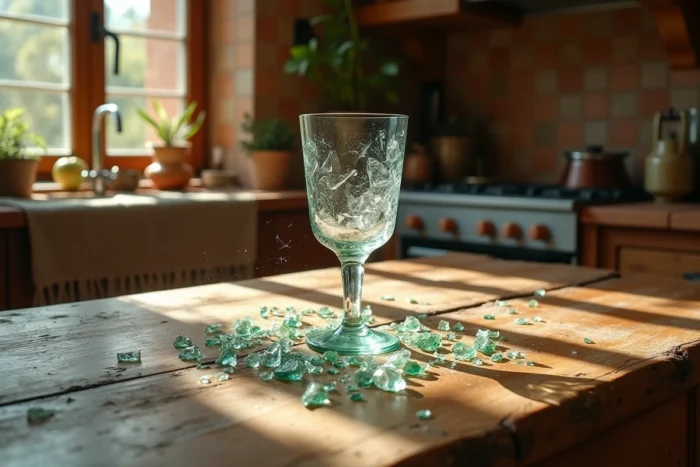
We clear the table after a family meal, a glass slips, shatters on the tile, and someone says: “Broken white glass, that’s a good sign!” This scene has been repeated for generations in French kitchens, with no one really knowing where this idea comes from. The omen of broken white glass is one of those beliefs that are passed down mechanically, between two sweeps of the broom, and that withstand the test of time much better than other superstitions.
White glass versus mirror: a distinction that conditions the entire omen
French popular tradition draws a clear line between accidentally broken white glass (a water glass, a carafe, a jar) and mirrors or colored glass. The former announces luck, the latter a curse.
This separation is based on the nature of the material: white glass, transparent and without a backing, holds nothing. The mirror, on the other hand, is supposed to capture a reflection, thus a part of the soul of the person looking into it.
According to the formulation reported by the Guichet du Savoir (service of the Municipal Library of Lyon), the rule is stated as follows: “as many fragments, as many friends,” with a variant that replaces friends with “years of happiness.” The broken mirror, on the contrary, promises seven years of bad luck, a belief found in England as well as in China, with local variations.
Thinking practically, the belief that breaking white glass brings good luck functions as a mechanism of de-dramatization: we have just lost an everyday object, and superstition transforms the accident into a good omen. The mirror, being more expensive and intimate, does not receive the same treatment.
Origins of the omen: what ancient sources allow us to trace
Tracing the exact roots of this belief is difficult because it belongs to oral folklore rather than a founding text. The works consulted by the Guichet du Savoir, notably I’m Not Superstitious: I’m Afraid It Will Bring Me Bad Luck! by Évelyne Keller, place the omen within a broader set of superstitions related to the fragility of objects.
Two threads intersect in the tradition:
- The ancient idea that a transparent object lets light through, thus positive energy, and that its destruction releases this energy all at once.
- The Russian practice of throwing one’s glass over the shoulder after a toast, a deliberate gesture this time, to seal a wish for luck. This ritual is found in contexts of celebration and festivity.
- The breaking of glass during a Jewish wedding, under the chuppah, which follows a completely different logic (memory of the destruction of the Temple, irreversibility of commitment), but which helps to anchor the image of broken glass as a gesture loaded with meaning.
These traditions do not share the same significance, but they mutually reinforce each other in the collective imagination. We eventually associate the sound of shattering glass with a moment that “counts.”
Why this superstition survives better than others
We no longer encounter many people who refuse to walk under a ladder for fear of bad luck. Black cats no longer make anyone back away in the street. The superstition of white glass, however, is still actively passed down at the table, in a convivial context, without any particular effort.
Several factors explain this resistance:
- The frequency of the triggering event: we break a glass much more often than we encounter a black cat. Each domestic accident reactivates the belief.
- The exclusively positive aspect of the omen: no one needs to protect themselves or ward off anything; it’s enough to smile and pick up the pieces. Superstitions with negative connotations require an effort (to avoid, circumvent, ward off) that people gradually abandon.
- The social dimension: the phrase “it’s white glass, it brings good luck” is said in front of witnesses, often by an elder. Transmission occurs through speech, in real situations, not through a book or an article. This mode of propagation is more robust than that of superstitions that require a rare context.
Returns vary on this point, but it seems that positive superstitions that are easy to activate persist longer than those that impose a constraint or generate anxiety. Broken white glass asks nothing of the believer, except to acknowledge the accident.
The role of the domestic context
The kitchen or dining room are spaces where popular traditions circulate unfiltered. One does not debate the validity of an omen while clearing the table. The remark is made, the children register it, and the loop is closed. This informal setting protects the belief from skepticism: no one is going to publish a study to refute a grandmother’s saying uttered between cheese and dessert.
In comparison, superstitions related to professional or external contexts (not opening an umbrella indoors, not placing a hat on a bed) disappear as the objects themselves fall out of common use. Glass, however, remains on every table.
Cultural meanings of broken glass beyond France
The French omen does not work everywhere. In Russia, the act of throwing the glass is deliberate and festive, which completely changes the relationship to the omen: one does not suffer the accident, one provokes it. In China, a broken mirror symbolizes marital separation, a register that has nothing to do with the luck or misfortune of white glass.
In the Jewish wedding ritual, the groom crushes a glass wrapped under his foot at the end of the ceremony. This gesture concentrates memory, commitment, and joy into a single act of breaking. The breaking of glass marks a threshold here, not a coincidence.
What distinguishes the French version is precisely its accidental nature. Happiness comes from what one did not seek to provoke. It is a passive superstition, almost lazy in its mechanics, and that is probably why it survives so well: it requires no ritual, no intention, no staging. Just a glass that falls.